期刊名称:ARCTIC SCIENCE
 期刊简介(About the journal)
投稿须知(Instructions to Authors)
编辑部信息(Editorial Board) 期刊简介(About the journal)
投稿须知(Instructions to Authors)
编辑部信息(Editorial Board)
About the journal

Scope
Arctic Science is a quarterly open-access peer-reviewed journal. An interdisciplinary journal, Arctic Science, publishes original research from all areas of natural science and applied science and engineering related to northern polar regions. The focus on basic and applied science includes the traditional knowledge and observations of the Indigenous peoples of the region, as well as cutting-edge developments in biological, chemical, physical and engineering science in all northern environments. Reports on interdisciplinary research are encouraged. Special issues and sections dealing with important issues in northern polar science are also considered.
Indexing information
CABI, EBSCO, and more.
Instructions to Authors
Abstract
Abstracts should not exceed 200 words for all article types.
Length per manuscript type
|
Article type |
Description |
Specifications (word, table/fig, reference limits) |
|
Article |
Reports a completed definitive study. |
There is no length restriction; however, in deference to our reviewers, manuscripts over 60 manuscript pages (including References, Figures, and Tables) will need to be justified and must be approved by the Editor prior to submission. |
|
Review |
Presents a critical perspective on a specific topic, particularly topics of current interest. |
Same as length limits of articles. |
|
Communication |
Intended for the presentation of brief observations. |
5000 words including references, tables and figures. |
|
Note |
Reports a completed project of a smaller scope |
4000 words including references, tables and figures. |
|
Discussions (Comments and Replies) |
Discussions of papers in recent issues of a journal may be accepted for publication, if they are brief and of a technical or interpretative nature. Replies to such discussions are invited from the original authors and are generally published in the same issue. |
2000 words including references, tables and figures. |
|
Data Paper *
(APC waived until April 15, 2022) |
Presents and describes a dataset (or datasets) in full, including the context, collection, and reuse potential of the data. |
5000 words including references, tables and figures. |
* Data Paper Instructions
Data papers should present a dataset (or datasets) relevant to the research community to promote discoverability and reuse of research data. Data papers should describe datasets in full, including the data’s purpose, collection, and reuse potential, but shouldn’t generally test hypotheses or provide any interpretations. Datasets must be deposited in a publicly accessible repository and licensed for reuse. Article Processing Charges for data papers will be waived until April 15, 2022.
Key components of a data paper:
- Overview of the project(s) that generated these data.
- Summary and citation of all publications derived from these data to date.
- Description of the data collected and the extent of the dataset (e.g., geography, time range).
- Description of data collection protocol such that other researchers can understand and reproduce the methods (includes procedures used to produce or gather data, experimental design, and any equipment or software used).
- Description of technical analyses or validation methods used to support the quality of the measurements and reliability of the data.
- Discussion of limitations (e.g., data gaps, changes in methods, instrumentation) and potential sources of error.
- Discussion of the dataset’s value to the research community: explains who can benefit from these data and provides examples for reuse.
- Instructions, code, workflows, or tips that may assist other researchers with reuse of these data.
Plain language summary
At acceptance, we encourage you to submit a plain language summary of your article in addition to your regular abstract. This summary should be concise, clear, and free of jargon. It should highlight why the work was done, how it was done, and what was discovered. Plain language summaries should be under 250 words long and include a short, plain language title that differs from the title of your article. You can submit a high-resolution image to accompany the summary. For more information, please see Writing a Plain Language Summary.
Upon publication, we may share the plain language summary with our readers, journalists, and the public via social media, news feeds, newsletters, and other means. With plain language summaries, we hope to reach a broader audience and encourage general interest in science as part of our greater science outreach strategy.
Endangered species
Authors must certify that research involving endangered species was conducted in conformance with all applicable laws.
Field research permits
Authors must include the research permit or licence number from the appropriate agency if it was required to access field areas (e.g. Scientific Research Licences or Wildlife Research Permits in Canadian Territories).
Nomenclature
Nomenclature should follow the rules established by international authoritative bodies such as the International Union of Biochemistry and Molecular Biology (IUBMB), the International Union of Pure and Applied Chemistry (IUPAC), the Chemical Abstracts Services (CAS), and the Committee on Nomenclature, Terminology, and Symbols of the American Chemical Society.
As a general guide for biological terms, Scientific Style and Format: The CSE Manual for Authors, Editors, and Publishers (8th ed., 2014) ), published by the Council of Science Editors, is recommended.
Bacteria: The use of genotypic and phenotypic designations should follow the recommendations of Demerec et al. (1966).
(i) Phenotypic designations must be used when mutant loci have not been identified or mapped. Phenotypic designations generally consist of three-letter symbols, not italicized, with the first letter capitalized. Superscript letters may be used (e.g., Strs for streptomycin sensitivity).
(ii) Genotypic designations are composed of three-letter locus symbols written in lower case italics. Wild-type alleles are indicated by positive superscripts (e.g., his+). If several loci control related functions, they are distinguished by italicized capital letters following the gene symbols (e.g., hisA, hisB). Mutation sites are indicated by putting the serial isolation numbers (allele numbers) after the locus symbol. Deviations from normal use should be defined. For more detailed information about the symbols in current use, consult reviews by Bachmann (Microbiol. Rev. 47: 180–230, 1983) for Escherichia coli K-12; Sanderson and Roth (Microbiol. Rev. 52: 485–532, 1988) for Salmonella spp.; and Henner and Hoch (Microbiol. Rev. 44: 57–82, 1980) for Bacillus subtilis.
Biochemical: Nomenclature should follow the rules recommended by the International Union of Biochemistry (IUB) Committee of Editors of Biochemical Journals with support of the International Union of Pure and Applied Chemistry (IUPAC).
Botanical: Refer to the International Code of Botanical Nomenclature (International Association for Plant Taxonomy). Note that the first occurrence of a species name in a manuscript is presented with the genus written in full and the authority name(s) included (e.g., Populus angustifolia James). In subsequent mentions of the same species, the genus is abbreviated to the first letter and no authority name(s) is listed (e.g., P. angustifolia). To avoid confusion, when different genera share the same first letter, the genera are written in full throughout the manuscript. Genera are always written in full at the beginning of a sentence.
Chemical: Refer to 1) A Guide to IUPAC Nomenclature of Organic Compounds (Recommendations 1993), 1993, Blackwell Scientific publications, Copyright 1993 IUPAC), 2)Nomenclature of Inorganic Chemistry (Butterworth, London, 1971), and 3) Quantities, Units and Symbols in Physical Chemistry (Blackwell, London, 1987) (https://old.iupac.org/publications/books/gbook/green_book_2ed.pdf).
Tentative recommendations exist for organometallic nomenclature, IUPAC Information Bulletin No. 31, 1973; for stereochemical designations, J. Org. Chem. 35, 2849, 1970; and for steroids, J. Org. Chem. 34, 1517, 1969.
Although tentative IUPAC rules have been published for carbohydrate nomenclature (Biochemistry, 10, 3983, 1971), the Editor-in-Chief recommends the use of the British–American nomenclature (J. Org. Chem. 28, 281, 1963), until the IUPAC rules become definitive.
For nomenclature not covered by international convention, the usage of the American Chemical Society should be followed, for example, The Naming and Indexing of Chemical Compounds.
Rigid adherence to nomenclature rules is not expected each time a compound is mentioned in a manuscript, but the approved names should be given at least once, preferably in an early part of the manuscript.
Enzymes: Refer to Enzyme Nomenclature (1992): Recommendations of the Nomenclature Committee of the International Union of Biochemistry and Molecular Biology (Academic Press, San Diego, California).
Geological: Should follow the American Geological Institute’s Glossary of Geology (1997) except where superseded by international recommendations, such as those of the International Union of Geological Sciences’ Subcommission on the Systematics of Igneous Rocks and of the International Mineralogical Association on the nomenclature of minerals. Abbreviations for mineral names should follow R. Kretz (American Mineralogist, 68: 277–279, 1983) and should be summarized in a footnote or figure caption. Stratigraphic nomenclature should follow the North American Stratigraphic Code (American Association of Petroleum Geologists Bulletin, 67: 841–875, 1983). Canadian lithostratigraphic units are summarized in the regional Lexicons of Canadian Stratigraphy published by the Canadian Society of Petroleum Geologists.
Geological Time: Only formal time-stratigraphic and geologic-time units should be capitalized, in accordance with Elsevier Science Publishers’ Geologic Time Table (2007). New 14C dates reported in manuscripts must include the laboratory reference number.
Geotechnical Symbols: Shall conform to those recommended by the Metric Subcommittee of the Canadian Geotechnical Society (Canadian Geotechnical Journal, 17: 89–96, 1980).
Microorganisms: Authors are required to use currently accepted names for microorganisms as indicated in the International Code of Nomenclature of Bacteria. A new name is not validly published until a note containing the name is also published in the International Journal of Systematic and Evolutionary Microbiology. Microorganisms and viruses should be given strain designations consisting of letters (usually two) followed by serial numbers. It is generally advisable to use the worker’s initials or a descriptive symbol of locate or laboratory. Each new isolate will then be given a new (serial) designation (AB1, AB2, etc.). Genotypic and phenotypic symbols should not be included.
Transposable elements and plasmids: Nomenclature of transposable elements (transposons, Mu) should follow Campbell et al. (Gene, 5: 197–206, 1979), and for plasmids, should follow Novick et al. (Bacteriol. Rev. 40: 168–189, 1976).
Viruses: In the genetic nomenclature of bacterial viruses (bacteriophages), no distinctions are made between genotype and phenotype. Genetic symbols may be one, two, or three letters.
Zoological: Authors are required to follow the International Code of Zoological Nomenclature. Specifically, authors should provide the authority name(s) and date for all genus- and species-level taxa at the first mention within the Abstract and within the text (but not in the title). In subsequent mentions of the same species, the genus is abbreviated to the first letter and no author name(s) or date is listed (e.g., S. plicata). Genera are always written in full at the beginning of a sentence. In the case of changed combinations, the authorship and date should be set in parentheses. For example, Ascidia plicata Lesueur, 1823 is cited as Styela plicata (Lesueur, 1823) when transferred to the genus Styela.
References
This journal uses the Harvard citation style. In-text citations take the form (author, year). References must be listed in alphabetical order according to the name of the first author and not numbered. References with the same first author are listed in the following order.
- Papers with one author only are listed first in chronological order, beginning with the earliest paper.
- Papers with dual authorship follow and are listed in alphabetical order by the last name of the second author.
- Papers with three or more authors appear after the dual-authored papers and are arranged chronologically.
Include DOIs and hyperlinks whenever possible, and do not number the references. If your article is accepted for publication, we will format the list for you.
Editorial Board
Editors-in-Chief
Dr. Lisa Loseto — Fisheries and Oceans Canada, Canada
Lisa Loseto is a Research Scientist at Fisheries and Oceans Canada in Winnipeg with the Arctic Aquatic Research Division. Lisa’s research focuses on characterizing beluga health as means to understand ecosystem health in the Western Canadian Arctic. She combines food web biotracers and habitat modeling to gain insight into predator-prey interactions and ecosystem energetics. Her research on beluga diet and habitat use combines Western science and traditional ecological knowledge (TEK). Her research programs are carried out in partnership with communities and co-management boards of the Inuvialuit Settlement Region. She strives to serve all Canadians by providing knowledge and advice to decision makers and by helping to empower the people of the north through scientific knowledge combined with their own knowledge of their ecosystem and home. Lisa obtained a B.Sc. Honours at York University in Toronto, a M.Sc. in toxicology at the University of Ottawa, and a PhD from the University of Manitoba. Lisa’s Post doctoral research on beluga health took a multi-disciplinary approach to examining contaminant and climate stressors. 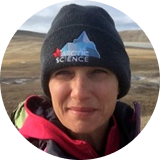
Dr. Melissa Lafrenière — Queen’s University, Canada
Melissa Lafrenière is a Professor in the Department of Geography and Planning at Queen’s University and is an adjunct at the Cold Regions Research Centre at Wilfred Laurier University. She received her Ph.D. in Earth and Atmospheric Sciences at the University of Alberta (2003). Her research examines the hydrological and biogeochemical response of watersheds in Canada’s cold regions to global change. Her work employs extensive field investigations, laboratory experimentation, and various analytical approaches (optical, elemental, and isotopic) to evaluate how changes in climate and permafrost conditions alter the loads and biogeochemical cycling of elements (e.g., carbon (C), nitrogen (N), metals, and contaminants) in surface waters in alpine and Arctic environments in Canada. Her recent projects are motivated by the need to better understanding the impact of changing permafrost conditions on water resources and water quality in Inuit communities. She has 23 years of field experience in glaciated and permafrost regions in Canada and is co-director of the Cape Bounty Arctic Watershed Observatory (CBAWO) on Melville Island, Nunavut, a long-term integrated watershed research site in the Canadian High Arctic.
Consulting and Founding EditorGreg Henry, University of British Columbia, Canada
Associate Editors
P. Archambault, Université Laval, Canada
T. Bell, Memorial University, Canada
D. Berteaux, Université du Québec à Rimouski, Canada
L. Brown, University of Toronto, Canada
L. Copland, University of Ottawa, Canada
M. Houde, Environment and Climate Change Canada, Canada
E. Humphreys, Carleton University, Canada
J. Iacozza, University of Manitoba, Canada
I. Svala Jónsdóttir, The University of Iceland, Iceland
Z.Z. Kuzyk, University of Manitoba, Canada
S. Lamoureux, Queen’s University, Canada
T. Lantz, University of Victoria, Canada
A. Lewkowicz, University of Ottawa, Canada
M. Mallory, Acadia University, Canada
D. Mueller, Carleton University, Canada
T. Pearce, University of Northern British Columbia, Canada
M. Power, University of Waterloo, Canada
J. Provencher, Environment and Climate Change Canada, Canada
M. Rautio, Université du Québec à Chicoutimi, Canada
S. Siciliano, University of Saskatchewan, Canada
H.Swanson, University of Waterloo, Canada
P. Treitz, Queen's University, Canada
W. Vincent, Université Laval, Canada
B.B. Wolfe, Wilfrid Laurier University, Canada
|

