期刊名称:HEALTH PROMOTION AND CHRONIC DISEASE PREVENTION IN CANADA-RESEARCH POLICY AND PRACTICE
 期刊简介(About the journal)
投稿须知(Instructions to Authors)
编辑部信息(Editorial Board) 期刊简介(About the journal)
投稿须知(Instructions to Authors)
编辑部信息(Editorial Board)
About the journal
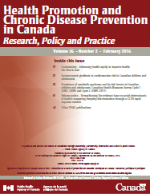
About Health Promotion and Chronic Disease Prevention in Canada: Research, Policy and Practice
a publication of the Public Health Agency of Canada
Published by authority of the Minister of Health.
© Her Majesty the Queen in Right of Canada, 2015
ISSN 2368-738X (On-Line)
Health Promotion and Chronic Disease Prevention in Canada: Research, Policy and Practice (the HPCDP Journal) is the monthly, online scientific journal of the Health Promotion and Chronic Disease Prevention Branch of the Public Health Agency of Canada. The journal publishes articles on disease prevention, health promotion and health equity in the areas of chronic diseases, injuries and life course health. Content includes research from fields such as public/community health, epidemiology, biostatistics, the behavioural and social sciences, and health services or economics.
The journal fosters collaboration between researchers, public health practitioners, health policy planners and related community professionals. It accepts articles resulting from a substantive collaboration with the Public Health Agency or Health Canada, through co-authorship (including with staff from the Canadian Institutes of Health Research), funding or use of Public Health Agency or Health Canada data. The journal also welcomes external articles by provincial or territorial government/public health agency authors that contain analysis of Canadian provincial and/or territorial data.
As part of its aim to increase policy relevant and intervention-related evidence that can help inform policy and practice decisions, the journal has recently expanded its types of articles. Please see Health Promotion and Chronic Disease Prevention in Canada: Information for Authors for article types and submission guidelines.
Indexed in Index Medicus/MEDLINE, SciSearch® and Journal Citation Reports/Science Edition
Instructions to Authors
Our Journal
CDIC has changed!
Chronic Diseases and Injuries in Canada (CDIC) has transitioned to a new publication model and a new name.
New name: Health Promotion and Chronic Disease Prevention in Canada: Research, Policy and Practice
In order to better reflect the current breadth of the journal content (disease prevention, health promotion and health equity in the areas of chronic diseases, injuries and life course health), a decision has been made to change the journal's name to Health Promotion and Chronic Disease Prevention in Canada: Research, Policy and Practice. The scope of articles (disease prevention, health promotion and health equity in the areas of chronic diseases, injuries and life course health) remains the same.
Journal mandate
Health Promotion and Chronic Disease Prevention in Canada: Research, Policy and Practice (the HPCDP Journal) is the monthly, online scientific journal of the Health Promotion and Chronic Disease Prevention Branch of the Public Health Agency of Canada. The journal publishes articles on disease prevention, health promotion and health equity in the areas of chronic diseases, injuries and life course health. Content includes research from fields such as public/community health, epidemiology, biostatistics, the behavioural and social sciences, and health services or economics.
The journal fosters collaboration between researchers, public health practitioners, health policy planners and related community professionals. It accepts articles resulting from a substantive collaboration with the Public Health Agency or Health Canada, through co-authorship (including with staff from the Canadian Institutes of Health Research), funding or use of Public Health Agency or Health Canada data. The journal also welcomes external articles by provincial or territorial government/public health agency authors that contain analysis of Canadian provincial and/or territorial data.
The journal achieves high scientific credibility through central inclusion of external associate scientific editors and peer reviewers, as well as an Editorial Board with more than half of its members external to the government. These external advisors contribute their expertise to review papers and ensure that the work published in the journal is of high quality and expands upon the latest pan-Canadian knowledge in this field.
Submissions are selected based on scientific quality, national public health relevance, clarity, conciseness and technical accuracy.
Article Types
Peer-reviewed Articles
Original Research Articles
Article Reporting on Quantitative Research: Maximum 3500 words in English (or 4400 words in French) for main text body (excluding abstract, tables, figures, references) in the form of original research, surveillance reports, or methodological papers. Please include a structured abstract (maximum 250 words in English, or 345 words in French). No more than 30 references.
Article Reporting on Qualitative Research or Mixed Methods: Maximum 5000 words in English (or 6500 in French) for main text body (excluding abstract, tables, figures, references). Methodological papers welcomed. Process evaluations that accompany qualitative analyses are welcomed. Please include a structured abstract (maximum 250 words in English, or 345 words in French). No more than 30 references. The HPCDP Journal follows the guidelines for qualitative articles as set by Social Science and Medicine . .
Article Reporting on Public Health Intervention: “Population health interventions are policies, programs and resource distribution approaches that impact a number of people by changing the underlying conditions of risk and reducing health inequities.” [CIHR, Population Health Research Initiative for Canada] Quantitative, qualitative or mixed methods studies and evaluations of interventions are welcomed. Maximum 3500-5000 words in English (4400-6500 words in French) for main text body (excluding abstract, tables, figures, references). Please include a structured abstract (maximum 250 words in English, or 345 words in French) with the following headings: Objectives, Participants, Setting and Context, Intervention, Evaluation Methods, Results, Conclusion. No more than 30 references.
Evidence Synthesis
Provides a systematic assessment of literature and relevant data sources (systematic review, meta analysis), a scoping review, realist review or an environmental scan. Authors should report the type of review they undertook and describe their methods for performing the review, including the ways information was searched for, selected, analyzed and summarized. Process evaluations that accompany systematic reviews are welcomed. Please follow accepted standards for the reporting of meta-analyses or systematic reviews (e.g. AMSTAR, PRISMA, QUORUM, MOOSE). Purely qualitative syntheses are accepted (e.g. realist reviews). Please follow accepted standards in qualitative reviewing (e.g. RAMSES for realist reviews/meta-narrative reviews). Maximum 4000 words in English (5000 words in French) for main text body (excluding abstract, tables, figures, references). Please include a structured abstract (maximum 250 words in English, or 345 words in French). References: no limit.
Evidence Brief
Describes results of interest to a broad audience of public health and related professionals. There should be no more than 6 figures or tables (total). Maximum 1500 words in English, or 1950 words in French. Please include an unstructured abstract (maximum 100 words in English, or 130 words in French). The unstructured abstract has no more than 5 sentences, each one corresponding to the subheadings in the body of the paper: Introduction, Methods, Findings, Discussion, Conclusion. No more than 20 references.
Non-Peer-reviewed Articles
Status Report
Describes ongoing national health promotion or chronic disease/injury prevention programs, studies or information systems bearing on pan-Canadian public health (maximum 2000 words in English, or 2600 words in French). May be peer reviewed and an abstract may be required at the request of the Editor-in-Chief. No more than 40 references.
At-a-Glance
Infographic, chart or diagram depicting trends or providing at-a-glance information on a specific public health issue with pan-Canadian relevance. May be accompanied by explanatory text of 500 words maximum (630 words in French) supporting or explaining the depicted information. No more than 6 references.
Report Summary
Maximum 1000 words in English, or 1300 words in French. The “Report Summary” allows authors of grey literature to have a summary of key findings appear in PubMed as “News”. Abstract not required.
Release Notice
Short announcement of the recent or upcoming release of datasets or reports relevant to public health in Canada.
Book/Media Review
Usually solicited by the editors (maximum 800 words in English, or 1000 words in French), but requests to review are welcomed. Abstract not required.
Letter to the Editor
Commentary on recently published journal articles or issues will be considered for publication (maximum 500 words in English, or 630 words in French). Comments must be received within one month of publication date to be considered. Abstract not required. No more than 6 references.
Submitting Manuscripts to the HPCDP Journal
Kindly submit manuscripts to the Editor-in-Chief of the journal at Journal_HPCDP-Revue_PSPMC@phac-aspc.gc.ca.
Since the HPCDP Journal generally adheres to the "Recommendations for the Conduct, Reporting, Editing and Publication of Scholarly Work in Medical Journals" as approved by the International Committee of Medical Journal Editors, authors should refer to this document (section on illustrations not applicable) for complete details before submitting a manuscript to the journal (see the International Committee of Medical Journal Editors).
To obtain a more detailed style sheet, please contact the Managing Editor at Journal_HPCDP-Revue_PSPMC@phac-aspc.gc.ca.
Checklist for Submitting Manuscripts
Cover letter/Conditions of authorship
Signed by corresponding or first author, stating that all authors have seen and approved the final manuscript. Must confirm that the material has not been published in whole or in part elsewhere and that the paper is not currently being considered for publication elsewhere. Must state that all authors meet the following conditions of authorship: authors were involved in design or conceptualization of the study, and/or analysis or interpretation of the data, and/or drafting of the paper. Should declare if an author has a conflict of interest, if applicable.
Please fax or email a scanned copy of the signed letter to 613-960-0921 or Journal_HPCDP-Revue_PSPMC@phac-aspc.gc.ca.
First title page
Concise title; full names, institutional affiliations and highest academic degree of all authors; name, postal and email addresses, and telephone and fax numbers for corresponding author only; separate word counts for abstract and text; indicate number of tables and figures.
Second title page
Title only; start page numbering here as page 1.
Abstract
Structured (Introduction, Methods, Results, Conclusion) where applicable; include 3-8 key words (preferably from the Medical Subject Headings [MeSH] of Index Medicus).
Highlights Box
Maximum 100 words (130 in French) to describe the highlights of the paper in plain language, bullet style.
Text
In Microsoft Word. Double-spaced, 1 inch (25 mm) margins, 12-point font size. For Original Research articles, please structure the paper with the following subheadings: Introduction, Methods, Results, Discussion, Conclusion. The Discussion section should contain a “Strengths and Limitations” subsection. The Conclusion should avoid statements that are not supported by the results of the investigation. For Public Health Intervention articles, please structure the paper with the following subheadings: Objectives, Participants, Setting and Context, Intervention, Evaluation Methods, Results, Conclusion. The Conclusion should avoid statements that are not supported by the results of the investigation.
Acknowledgments
Include disclosure of financial and material support in acknowledgements; if anyone is credited in acknowledgements authors should state in their cover letter that they have obtained written permission.
References
In Vancouver style; listing up to six authors (first three and "et al." if more than six). Numbered in superscript in the order cited in text, tables and figures. Please do not use an automatic reference numbering feature found in word processing software. Any unpublished observations/data or personal communications used (discouraged) to be cited in the text in parentheses (authors are responsible for obtaining written permission). Authors are responsible for verifying accuracy of references and hyperlinks.
Tables and Figures
If created in Word, please place at the end of the main manuscript. If created in Excel, please place in one separate file. They must be as self-explanatory and succinct as possible; numbered in the order that they are mentioned in the text; explanatory material for tables in footnotes, identified by lower-case superscript letters in alphabetical order; figures limited to graphs, flow charts or diagrams, or maps (no photographs). If figures are submitted in Word, raw data will be requested if the manuscript is accepted for publication.
Data
The most recent source of available data should be used for research and analysis, unless comparing across time.
Ethics in Publishing
Since the journal generally adheres to the "Recommendations for the Conduct, Reporting, Editing and Publication of Scholarly Work in Medical Journals" as approved by the International Committee of Medical Journal Editors, authors should refer to this document for information regarding ethical considerations.
Revision Process
For peer-reviewed articles: Submitted articles first undergo an initial assessment by the Editor-in-Chief and an external Associate Scientific Editor as to the suitability of the manuscript for publication with our journal. If the manuscript fits within our mandate, it will need to pass through a streamlined institutional review process prior to peer-review. Then the article will undergo a double-blind peer-review process. Once the reviews have been received, the Associate Scientific Editor assigned to the article will adjudicate the reviews and make one of the following recommendations: “accept,” “reconsider after minor revisions,” “reconsider after major revisions” or “reject”.
For non-peer-reviewed articles: Submitted articles first undergo an initial assessment by the Editor-in-Chief and, if deemed necessary, by an external Associate Scientific Editor as to the suitability of the manuscript for publication with our journal. If the manuscript fits within our mandate, it will then need to pass through a streamlined institutional review process. Revisions may be requested.
Copyright
The Public Health Agency of Canada requests that authors formally assign in writing their copyright for each article published in the journal. Once the article is accepted for publication, a copyright waiver will be distributed to the authors of the article for signature. For more information, please contact the Managing Editor at Journal_HPCDP-Revue_PSPMC@phac-aspc.gc.ca.
Editorial Board
Robert Geneau, PhD
Editor-in-Chief
Barry Pless, CM, MD, FRCPC
Associate Scientific Editor
Elizabeth Kristjansson, PhD
Associate Scientific Editor
Gavin McCormack, PhD
Associate Scientific Editor
Paul Villeneuve, PhD
Associate Scientific Editor
Michelle Tracy, MA
Managing Editor
Donna Lahey
Assistant Production Editor
Sylvain Desmarais, BA, BEd
Production Editor
Joanna Odrowaz, BSc
Freelance Copyeditor
Anna Olivier, PhD
Freelance Copyeditor
HPCDP Journal Editorial Board
Erica Di Ruggiero, PhD
University of Toronto
Brent Hagel, PhD
University of Calgary
Isra Levy, MB, FRCPC, FACPM
Ottawa Public Health
Lesli Mitchell, MA
Centers for Disease Control
and Prevention
Howard Morrison, PhD
University of Ottawa
Candace Nykiforuk, PhD
University of Alberta
Scott Patten, MD, PhD, FRCPC
University of Calgary
Richard Stanwick, MD, FRCPC, FAAP
Island Health
Ania Syrowatka, MSc
McGill University
Wendy Thompson, MSc
Public Health Agency of Canada
Andreas T. Wielgosz, MD, PhD, FRCPC
Public Health Agency of Canada
Russell Wilkins, MUrb
University of Ottawa
Cameron Willis, PhD
University of Waterloo
Health Promotion and Chronic Disease Prevention in Canada
Public Health Agency of Canada
785 Carling Avenue
Address Locator 6809B
Ottawa, Ontario K1A 0K9
|

