期刊名称:PALAEONTOGRAPHICA ABTEILUNG B-PALAEOPHYTOLOGIE PALAEOBOTANY-PALAEOPHYTOLOGY
 期刊简介(About the journal)
投稿须知(Instructions to Authors)
编辑部信息(Editorial Board) 期刊简介(About the journal)
投稿须知(Instructions to Authors)
编辑部信息(Editorial Board)
About the journal
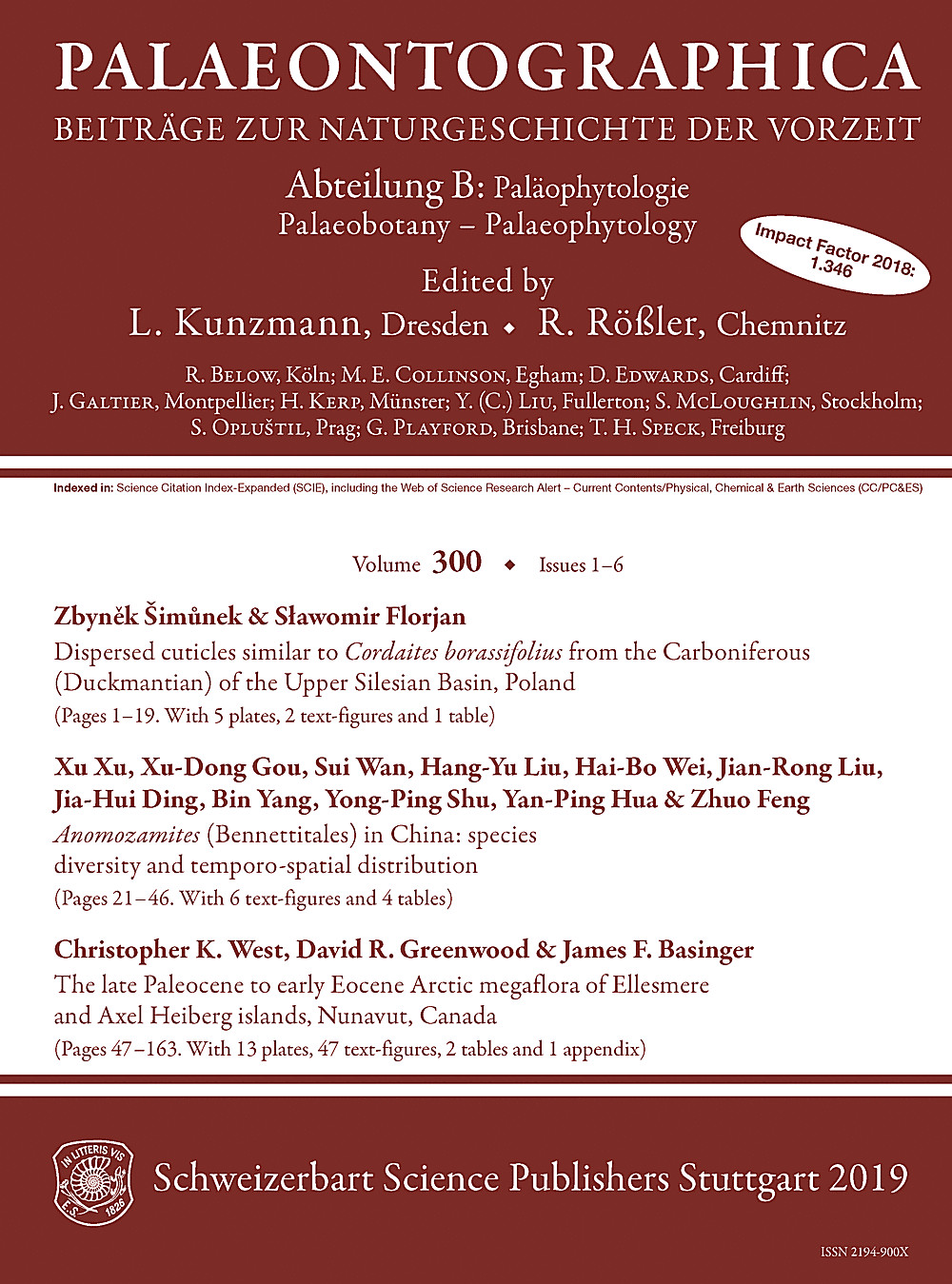
Section B of Palaeontographica publishes contributions to palaeobotany, i.e. papers on morphological traits, systematics and phylogenetic features of plants as well as papers on palaeoclimatology and palynogeography. Especially worth mentioning are the comprehensive monographs published in Palaeontographica B on specific floras or plant groups. Often palaeoclimatic or stratigraphic problems are clarified by resorting to palaeobotanical data published in Section B of Palaeontographica.
Throughout the last decades, numerous objects important to palaeophytology have been found in many places all over the world. As Palaeontographica publishes papers on floras on any parts of the world to report world-wide research, contributions in German, English and French have been published since the beginning of the journal, today English language publications are preferred.
Palaeontographica B is of interest to palaeobotanists, palynologists, palaeoclimatologists, stratigraphers and the libraries of all institutions engaging in such research.
Palaeontographica Section B is indexed in:
- Science Citation Index Expanded (SCIE©) including the Web of Science Research Alert
- Current Contents©/Physical, Chemical and Earth Sciences (CC/PC&ES)
Publication information
2-3 volumes are published per annum. 1 volume consists of 1-2 issues.
Instructions to Authors
Submission policy/declarations
Submission of a manuscript for publication in Palaeontographica Section B is considered binding assurance from the author that this work has not been published previously in this form, has not been submitted elsewhere for publication, and if accepted will not be published elsewhere in this form, length, language and any other language. The manuscript has to be approved by all authors and should be free of any potential conflict of interests. Research work presented in this article must be carried out with the rules of good scientific practice.
With acceptance and publication of a manuscript the exclusive copyright for every language and country is transferred to the publishers. The copyright covers the exclusive rights to reproduce and distribute the article including reprints, microfilm or any other reproductions and translations.
For technical reasons, printing of papers in order of receipt cannot be guaranteed.
Manuscript submissionOriginal manuscripts are to be submitted electronically by e-mail or on a CD/DVD to one of the editors in chief.
Submission must include a cover letter, the manuscript and illustrations. Tables, text-figures and plates are not embedded in the manuscript text and have to be submitted as separate files. Files of illustrations and plates can be delivered on CD/DVD if file sizes prevent sending as e-mail attachments. When submitting by email please reduce figure resolution or use file transfer services. Upon acceptance of an article authors need to be able to supply the Publishers with high resolution figure/plate files.
Manuscript preparation
Only wordprocessor prepared manuscripts are acceptable. The text body has to be outlined as follows: single column, 12 pt font size, double-spaced, left justification. Lines are consecutively numbered from the beginning. Please avoid manual hyphenation of words (it is better to not hyphenate at all). Please use italics only for genera and species names, not for names of higher taxa, not for names with Latin suffixes; not for additions like "cf.", ”aff.”, ”sp.” and “sp. nov.”; not for accentuation of words within the text. Do not attempt to indicate different type faces for headings and subtitles. Use SMALL CAPITALS for all author names.
Footnotes are to be consecutively numbered and entered at the bottom of the page where they appear under a horizontal line. Use of footnotes should be kept to a minimum.
References must include the author's name and year of publication of each paper.
Any abbreviations used must be uniform and consistent.
Title of the paper, abstract, keywords, all figure and plate captions and table explanations have to be given additionally in English, if the article is not written in English.
Structure of the paper
- Title page should contain:
- Title of the paper (as short and precise as possible; subtitles and words in parentheses are to be avoided)
- First and last names of the author(s), affiliations, addresses, contact details of the corresponding author (e-mail address, telephone number)
- Abstract
- Key words: Up to 5 key words, respectively. These should facilitate correct classification in subject areas for data processing (e. g. key words = angiosperm pollen, ultrastructure, northern Gondwana, Early Cretaceous, South America)
- Table of contents: The sections and subtitles of the table of contents must correspond to the structure of the main text. Sections and subsections are numbered using Arabic numbers. Please avoid more than three levels of subsections.
- Introduction should contain:
- General description of the topic / the objectives of interest
- Discussion of previous work (background)
- Explanations of special features and abbreviations in the text
- Methodology and techniques used in the investigations, material investigated
- Results and discussion
- Conclusions or Summary
- Acknowledgements or recognition of research assistance
- References
- Appendix or glossary
- Plates and explanation of plates
Description of species
Nomenclature must strictly follow the most recent issue of the International Code for Nomenclature of algae, fungi and plants (from 2012 onwards: ‘Melbourne Code’). Spelling of author names should follow Brummit & Powel (1992, 1996) and the ‘Authors of Plant Names’ online database in the International Plant Names Index database (www.ipni.org). Each taxon name must be accompanied by the author(s) name(s) and year of publication when introduced for the first time in the text.
In open nomenclature abbreviations cf., aff., sp. nov., gen. nov., gen. nov. et sp. nov., comb. nov. etc. are to be used without further additions.
In synonymy lists, species names and literature references are separated by a dash in cases where the describer is not the original describer of the species. Examples:
1821 Annularia spinulosa STERNBERG, vol. I, 2: p. 32, pl. 19, fig. 4.
2000 Annularia spinulosa STERNBERG – BARTHEL, p. 39, figs 2–5.
Referring to types and typoids indicates the location of collection (abbreviated) and catalogue number of the fossil. It is strongly recommended that all materials described and figured in the manuscript are kept in a public collection.
Stratigraphic nomenclature
Please observe the guidelines of the International Commission on Stratigraphy (ICS) on their website for using stratigraphic divisions and names of the most recent International Stratigraphic Chart and for correct use of any stratigraphic terms.
Illustrations and plates
Illustrations and plates are only accepted in digital format in appropriate resolution (for details see below). High-resolution versions of illustrations can be delivered by CD/DVD; for peer-review reasons the text files submitted by e-mail can be accompanied by illustration files of lower resolution.
Illustrations (line-drawings; diagrams; photographs if necessary) in the text are to be labeled as "Text-fig." and numbered consecutively. Labeling must be large enough to allow necessary reductions in size (characters must have a final size of at least 2 mm (after reduction)). Indicate the scale for all figures in the explanatory text and use a scale bar whenever possible. Avoid the use of serif typefaces when labeling illustrations. Please indicate the approximate place(s) in the text where the text-figure(s) should be located.
Photographs are digitally mounted on photo plates; the individual photographs on the plates are called "Fig.". Both plates and figures are numbered using Arabic numbers. Spaces between individual photographs have to be equally sized on all plates and should not exceed 2 mm. If inscriptions are in need please use Helvetica or Arial typeface. If necessary use arrows or arrowheads and explain them in the plate captions. The type area for plates is 17.5 x 23 cm and should not be exceeded. Please avoid plates that have a size less than the maximum type area.
Only a limited number of photo plates (max. 20) can be accepted for each paper without printing charges. The appropriate number of plates will be fixed by one of the editors-in-chief. If you wish to publish more than 20 photo plates, please contact one of the editors-in-chief before manuscript preparation.
File format: Files of line-art figures must be supplied in tif- or eps-format (please avoid Corel Draw graphics) at a resolution not less than 600 dpi. Photographs and photo plates must be provided at a minimum resolution of 300 dpi in tif-, eps- or jpg-format. Please be sure that in eps-files all fonts are embedded.
Colour figures and plates: For each paper each page printed in full color is charged with EUR 34.90. All prices plus VAT.
Literature references
We request that "The List of Title Word Abbreviations" of the ISSN International Centre is used for journal name abbreviations (e.g. see http://scieng.library.ubc.ca/coden/ or http://library.caltech.edu/reference/abbreviations/). Examples for reference style:
NORTON, N. J. & HALL, J. W. (1969): Palynology of the Upper Cretaceous and Lower Tertiary in the Type Locality of the Hell Creek Formation, Montana, U.S.A. – Palaeontographica Abt. B, 125 (1–3): 1–64.
CORDA, A. J. (1845): H. Pflanzen. – In: REUSS, A. E.: Die Versteinerungen der böhmischen Kreideformation. – pp. 1–148 (E. Schweizerbart'sche Verlagsbuchhandlung) Stuttgart.
TAYLOR, T. N. (1981): Paleobotany: An introduction to fossil plant biology. – pp. 1–589 (McGraw-Hill Book Co.) New York.
FISCHER, O. (1990): Blätterfloren aus mitteleozänen Sedimenten des südlichen Weißelster-Beckens (Profen und Scheiplitz). – pp. 1–142, unpublished PhD thesis, Humboldt University Berlin.
International Plant Names Index (2012): Published on the Internet http://www.ipni.org [last accessed 1 July 2012].
All publications referred to in the text of the paper must be included in the reference list.
ProofsThe corresponding author will receive a low resolution PDF of the proofs prior to printing by e-mail. This proof is supplied for proofing purposes only (no further distribution on any website, via mailing lists, no storage in private or institutional repositories etc.). We request that the annotated PDF proofs will be returned to the publishers immediately. If the proofs are not returned within the period indicated, the paper will be published without author’s corrections.
Author's corrections in proof must not exceed 10% of the typesetting costs; above that, the authors will be charged.
Reprints40 reprints of each article or a PDF for personal use only will be supplied free of charge; additional copies may be obtained at cost price.
Instructions to Authors
palb_instructions_to_authors_en.pdf
Editorial Board
Chief editorsLutz Kunzmann
Senckenberg Naturhistorische Sammlungen Dresden /
Senckenberg Natural History Collections Dresden
Königsbrücker Landstraße 159
01109 Dresden, Germany
palb@senckenberg.de
Ronny Rößler
Museum für Naturkunde
Moritzstraße 20
09111 Chemnitz, Germany
palb@naturkunde-chemnitz.de
Editorial board
Raimond Below
Universität Köln
Department of Geology
Köln, Germany
adh04@uni-koeln.de
Margaret E. Collinson
Department of Geology
Royal Holloway and Bedford New College
University of London
Egham, Great Britain
m.collinson@gl.rhul.ac.uk
Dianne Edwards
Department of Geology
University of Wales
College of Cardiff
Cardiff, Great Britain
edwardsd2@cardiff.ac.uk
Jean Galtier
UMR, Botanique et Bioinformatique
CIRAD, TA40/PS2
Montpellier, France
jean.galtier@cirad.fr
Hans Kerp
Forschungsstelle für Paläobotanik
am Institut für Geologie und Paläontologie
Münster, Germany
kerp@uni-muenster.de
Yushen (Christopher) Liu
Office of Research & Economic Development
Department of Earth & Environmental Sciences
University of Missouri-Kansas City
Kansas City, Missouri, USA
y.liu@umkc.edu
Stephen McLoughlin
Department of Paleobotany
Swedish Museum of Natural History
Stockholm, Sweden
steve.mcloughlin@nrm.se
Stanislav Opluštil
Institute of Geology and Palaeontology
Charles University
Prague, Czech Republic
oplustil@natur.cuni.cz
Geoffrey Playford
Department of Earth Sciences
University of Queensland
St. Lucia Campus
Brisbane, Australia
g.playford@earth.uq.edu.au
Thomas Speck
Plant Biomechanics Group Freiburg
Botanischer Garten der Universität Freiburg
Freiburg, Germany
thomas.speck@biologie.uni-freiburg.de
| 

 Download as PDF