期刊名称:BRAIN CONNECTIVITY
 期刊简介(About the journal)
投稿须知(Instructions to Authors)
编辑部信息(Editorial Board) 期刊简介(About the journal)
投稿须知(Instructions to Authors)
编辑部信息(Editorial Board)
About the journal
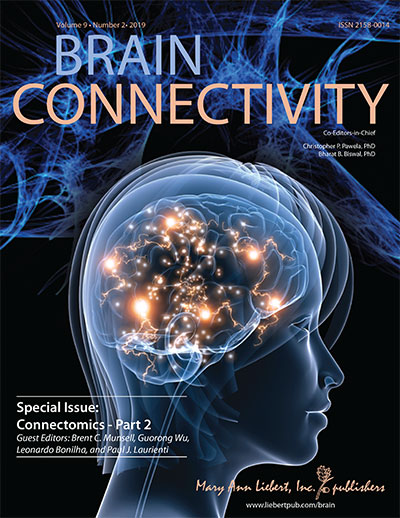
Brain Connectivity is an international neuroscience journal dedicated to the publication of innovative research, scientific reviews, and academic communications pertaining to all aspects of anatomical, functional, and causal connections between distinct units within the central nervous system.
Brain Connectivity coverage includes:
- Advances in neuroimaging using PET and MRI in Alzheimer’s disease, Parkinson’s disease and other neurodegenerative diseases
- Clinical translation of novel PET and MRI biomarkers in neurodegenerative diseases and Stroke
- How different pathological substrates influence structural and functional connectivity in brain disorders
- Multimodal imaging in brain disorders in both human and animal models
- Experimental techniques combining magnetic resonance imaging (MRI) (connectivity), electroencephalography (EEG), magnetoencephalography (MEG), positron emission tomography (PET), single photon emission computed tomography (SPECT), and other new and evolving methods
Under the editorial leadership of Editor-in-Chief Paul Edison, MD, PhD, FRCP, FRCPI Imperial College London, and other leading investigators, the journal will report original investigations in the areas of neuroscience, neurology, physics, biophysics, computer science, neuroinformatics, developmental biology, genetics, molecular biology, psychiatry, pharmacology, anesthesiology, cell biology, and brain anatomy relevant to the field of brain connectivity. View the entire editorial board.
Audience: Neuroscientists, biophysicists, medical physicists, neuroanatomists, neurologists, neurosurgeons, psychiatrists, psychologists, cognitive neuroscientists, mathematicians, statisticians, regenerative medicine researchers, developmental biologists, behavioural scientists, imaging scientists and computational biologists.
- PubMed/MEDLINE
- PubMed Central
- Web of Science Emerging Sources Citation Index (ESCI)
- Current Contents®/Life Sciences
- Science Citation Index Expanded
- Journal Citation Reports/Science Edition
- EMBASE/Excerpta Medica
- Scopus
- ProQuest databases
Instructions to Authors
Submitting Your Manuscript
Brain Connectivity is an international neuroscience journal dedicated to the publication of original research, communications, and scientific reviews concerned with all aspects of anatomical, functional, and causal connections between distinct units within the central nervous system. The journal will consider studies in both human and animal models.
Brain Connectivity is an investigational journal, and research reports are strongly recommended to contain experimental data. Three article categories will be included: original articles, communications, and review articles. Several sub-categories under original articles and communications will be considered, including reports of original experimental data, methodological studies, novel data analysis schemes, theoretical data modeling, and descriptions of changes in brain connectivity in health and disease. Reports of original investigations in the areas of neuroscience, neurology, physics, biophysics, computer science, neuroinformatics, mathematics, chemistry, biochemistry, physiology, developmental biology, genetics, molecular biology, psychiatry, pharmacology, anesthesiology, cell biology, and brain anatomy relevant to the field of brain connectivity will be accepted.
Articles describing the underlying mechanisms and structure behind brain connections will be given priority. Emphasis will be placed on the following experimental techniques:
- Magnetic resonance imaging (MRI)
- Positron emission tomography (PET)
- Magnetoencephalography (MEG)
- Single photon emission computed tomography (SPECT)
- Electroencephalography (EEG) along with other imaging modalities
- Microscopy
- Other new and evolving methods as applied to brain connectivity analysis
- Submission of multimodal examinations and integrations is encouraged
ORCID IDs
The submitting author is required to complete the submission using an ORCID identifier. Please visit the ORCID website for more information, or to register. You must have an account in ScholarOne for Brain Connectivity before logging in with an ORCID identifier.
Manuscript Submission Site
Create an Account in ScholarOne
If you do not already have an account in ScholarOne for Brain Connectivity, you will need to create one. Once you create your account, you may log in to the system to begin your submission. Each listed author on a submission must either have an account, or have one created, in the submission system.
CLICK HERE TO SUBMIT YOUR MANUSCRIPT
See JOURNAL STANDARDS AND BEST PRACTICES STATEMENT
Check the Journal’s PEER REVIEW POLICIES
Manuscript Preparation
Manuscripts that do not conform to the requirements herein may be returned to the submitting author with a request for proper formatting prior to peer review.
Determining Authorship
(See AUTHORSHIP DEFINITION AND RESPONSIBILITIES)
All authors, including the co-authors, should be responsible for a significant part of the manuscript. All authors and co-authors should have taken part in writing the manuscript, reviewing it, and revising its intellectual and technical content. Any author whose name appears on a manuscript assumes responsibility and accountability for the results.
Submission Process
CLICK HERE FOR ARTICLE TYPES AND WORD LIMITS
All Original submissions containing human subjects must include:
- An Institutional Review Board (IRB) approval (or waiver) statement in the Methods section
- Patient Consent statement in the Methods section
- Acknowledgments section (if applicable) after the Conclusion of the manuscript, followed by
- An Author Contribution statement for each listed author, followed by
- An Author Disclosure Statement for each author listed on a submission, even if there are no conflicts to disclose, followed by,
- Funding statement(s), even if there is no funding information to declare.
See IRB APPROVALS, PATIENT CONSENT, & ETHICAL TREATMENT OF ANIMALS
See AUTHOR CONFIRMATION AND DISCLOSURE STATEMENTS
See FUNDING INFORMATION: COMPLIANCE AND STATEMENTS
Note: Just Accepted / Instant Online Publication
Brain Connectivity publishes all accepted papers within 72 hours of receipt of all authors' signed copyright agreement forms in their unedited, uncorrected format.
It is important to note that the information that is published online, and in all indexing services, is pulled directly from the data that are populated into the fields in ScholarOne – NOT from the manuscript file – when the paper is originally uploaded to the system for peer review. Consequently, any errors contained in the system will remain on our website and all indexing services, including Medline, until the next revision* of the article is published. As such, it is critical that authors enter all authors’ names correctly into the system at the time of submission. Any omissions or errors will remain on our website and in indexing services until the subsequent online version is published.
*The next revision will take place after the corresponding author reviews page proofs, makes any necessary corrections, and returns the changes to the Publisher. Once the alterations are completed, the revised version will be published on our website, and the newly corrected information will then be released to Medline/PubMed, in addition to any other indexing services in which the Journal is included.
Please note that the typical time between acceptance of a paper and page proof distribution is approximately 4 (four) weeks depending on the length and complexity of the paper.
Supplemental Information, if supplied, will NOT be published in the Just Accepted/LION platform, but instead will be published in the Online Now (epub) and final versions of the article. Supplemental Information will not be copyedited or typeset; it will be posted online as supplied.)
All manuscripts must be prepared in accordance with the Uniform Requirements for Manuscripts Submitted to Biomedical Journals.
When submitting your manuscript for peer review, be prepared to:
- Use Arial font, in 11 points
- Enter the full title of the manuscript
- Enter the full names and institutional affiliations of ALL listed authors
- Enter ALL listed authors' institutional email addresses
- Identify the corresponding author
- Enter a running (abbreviated) title of no more than 60 characters (including spaces).
- Enter 3–6 keywords or phrases to assist in the selection of skilled reviewers in the field for the purposes of peer review.
- Provide a structured abstract of no more than 250 words
- Include an Impact Statement of 100 words or less describing the importance of the presented research and its potential effect on the field. The placement of this text must be included within the main text file, immediately following the abstract.
- Provide the names and email addresses of at least five potential preferred reviewers familiar with the field. Please make sure preferred reviewers are not from your university or institution or with whom you have collaborated. Anyone whom the author does not want to be considered should also be named as a non-preferred reviewer. Ultimate reviewer selection is at the Editor’s discretion.
- Confirm that the material has not been published or submitted for publication elsewhere.
Cover Letter
All submissions should be accompanied by a cover letter. Authors may convey any relevant information they wish to the Editor, but the cover letter must also assert the following:
- Each author listed on the submission contributed significantly to the work;
- The author listing is complete;
- No fraudulent or manipulated data were used;
- All reported data and results are authentic and valid;
- No content of the submission has been plagiarized.
Create an Effective Title
- Manuscript titles should be brief, contain key terms, and clearly identify the purpose of the work conducted
- Manuscript titles should not exceed 15 -18 words. Exceptions can be made with the Editor’s approval
- Manuscript titles should be direct and to the point. Remember that the journal has a global readership, so clear and concise non-vernacular language is most effective
- Avoid the use of specific locations in the title
- Do not use proprietary/trademarked names in the title
- Do not use acronyms in the title unless they are universally recognized and accepted
- NOTE: The title page of your submission must be included as part of your main text document (not as a separate file).
File Naming
All file names should be in English and contain only alphanumeric characters. Do not include spaces, symbols, special characters, dashes, dots, or underscores. Label each file with the content of the file (i.e.: Text; Tables; FigureLegends; Fig1, etc.)
Important: Please upload individual files of all manuscript material as described herein — please do NOT upload a combined PDF file containing all material in your submission.
Preparation of Manuscript
Prepare text of manuscripts, figure legends, and tables in Microsoft Word, double spaced. The order of elements in each manuscript should be:
- Title page (with full manuscript title, all contributing authors and their institutional affiliations including full postal address, city, state, country name, and email addresses, a short running title, the name, address, telephone and fax numbers, and e-mail address of the corresponding author, and a list of 3-6 key words)
- Structured Abstract (include: Background / Introduction; Methods; Results; and Discussion)
- Impact Statement
- Main text (do not embed figures or tables)
- Conclusion (as a separate paragraph, not as part of the Discussion section)
- Acknowledgments (if applicable)
- Authorship Confirmation Statement (detailing each author’s contribution to the work)
- Author(s’) Disclosure Statement(s) (actual or potential)
- Funding statement (include funding institution information and grant numbers; if no funding was received, include such a statement)
- References (name/date in text; alphabetical in the reference section. Not in numeric order.)
- Figure legends (all legends in one separate Word file, double-spaced)
- Tables (all tables in one separate Word file; do not include tables as part of the main text file)
- Supplemental files (if applicable. If the submission is accepted, Supplemental Information will NOT be published in the Just Accepted/LION platform, but instead will be published in the Online Now (epub) and final versions of the article. Supplemental Information will not be copyedited or typeset; it will be posted online as supplied.)
Note: The keywords are search terms that will aid in the discoverability of the article in indexing services and search engines. These terms may or may not be different from the terms you selected for the peer review process and areas of expertise. You will be asked to retype these search terms in the submission form when uploading your manuscript. These keywords will be included in the published article. If the search terms entered do not match the manuscript, the manuscript will serve as the default.
Abstract
A structured abstract should accompany every original manuscript, review manuscript, or brief communication/report. The abstract should appear on a separate page after the title page and should conform to the following guidelines:
- Do not use proprietary or trade names in the abstract
- The use of the first person should be avoided
- Clearly summarize the results and conclusions of the work
- References are not permitted in the abstract
Impact Statement
After the abstract, include a statement of 100 words or less describing the importance of the presented research and its potential effect on the field. The placement of this text must be included within the main text file, immediately following the abstract.
Manuscript Text
Maximum word count for original articles should not exceed 5,000 words. In general, the text should be organized under the headings: Introduction, Materials and Methods, Results, Discussion, and Conclusions. Number and double space all pages. Provide an Impact Statement of 100 words or less describing the importance of the presented research and its potential effect on the field. This text must be included within the main text file and placed immediately following the abstract.
Basic Science submissions must contain a Clinical Trial Registration number.
Brain Connectivity discourages the use of unnecessary acronyms. Overuse of acronyms can cause reduced clarity and therefore the use of acronyms should be limited whenever possible. Use only standard abbreviations, which can be found in the AMA’s Manual of Style for Authors & Editors or the Council of Biology Editors Style Manual, 10/e. At first usage, spell out terms and provide abbreviations in parentheses. Thereafter, use only the abbreviations. It is not necessary to spell out standard units of measure. Use generic names for drugs if possible. If you wish to use a proprietary drug name the first time it appears, use the generic name followed by the proprietary name, manufacturer, and location in parentheses.
References
The reference section must be double-spaced, and should be arranged in alphabetical order, and not numbered. More than one reference from the same author(s) in the same year must be identified by the letters "a," "b," "c," etc., placed after the year of publication (i.e.: 2020a), and should be listed chronologically, beginning with the most recent year. If a reference has more than three authors, list the first three, followed by et al.
Within the text, the citation and year of publication should be included in parentheses [e.g.: (Smith, et al., 2019)]. Use journal abbreviations as provided by PubMed/Medline. Any references cited in the text must be included in the reference list, and conversely, all references in the reference section must be cited in the text.
If references to personal communications, unpublished data, or manuscripts in preparation or submitted but not in press are used, they are not to be in the list of references. They should be referred to in the text in parentheses: (AB Jones, personal communication, month and year of communication). Include among the references any articles that have been accepted but have not yet published; identify the name of publication and add "In Press." If the reference has been published online, provide the DOI number in place of the page range.
Sample style for references:
Journal article:
Smith SD, Fredborg BK, Kornelsen J. Atypical functional connectivity associated with autonomous sensory meridian response: an examination of five resting-state networks. Brain Connect 2019;9:508-518.
Book:
Cardoso MJ, Arbel T, Ferrante E, Pennec X, Dalca AV, Parisot S, et al., eds. Graphs in Biomedical Image Analysis, Computational Anatomy and Imaging Genetics. Cham, Switzerland: Springer International Publishing; 2017, p. 3–11.
Chapter in a book:
Arslan S, Rueckert D. Multi-level parcellation of the cerebral cortex using resting-state fMRI. In: Navab N, Hornegger J, Wells WM, Frangi AF, eds. Medical Image Computing and Computer-Assisted Intervention—MICCAI 2015, Part III. Cham, Switzerland: Springer International Publishing; 2015, p. 47–54.
Note: For books and book chapters, include the volume and/or edition numbers when appropriate.
Conference Abstracts:
Douaud G, Groves A, Tamnes C, Westlye L, Engvig A, Wavhold K, et al. Mode of variation in brain structure identifies network linking protracted development, early degeneration and vulnerability to disease. In: Proceedings of the Joint Annual Meeting ISMRM-ESMRMB, Milan, Italy, 2014.
Websites:
Schildkrout B. Functional connectivity: probing the brain’s astounding complexity. 2018. www.psychiatrictimes.com/view/functional-connectivity-probing-brains-astounding-complexity Last accessed June 16, 2020.
Note: Do not include http:// in a website address if www. is present in the URL; include it only if www. is omitted.
Figure Legends
Figure legends should be uploaded as a separate Word file and double spaced. In the legend, provide explanations for any abbreviations, arrows, etc., that appear in the figure. Define all relevant information in figures, including figure part labels, footnotes, abbreviations, acronyms, arrows, and levels of magnification in insets. If the illustration is taken from a copyrighted publication, permission must be secured by the authors, appropriate credit must be given in the legend, and a corresponding reference must appear in the reference section.
Tables
All tables should be prepared in one separate Word file. Provide a title for each table. Each numbered table should begin on a new page. Cite tables in sequence in the text. Explain abbreviations used in the body of the table in footnotes. All other types of table footnotes should be designated using superscript letters, not symbols. If the table is taken from a copyrighted publication, permission must be secured by the authors, appropriate credit must be given in the table legend, and a corresponding reference must appear in the reference section.
Figures
The depiction of data presented in Brain Connectivity is of the utmost importance to our readers.
- Submission of high resolution .TIFF or .EPS figure files is strongly recommended.
- Figures should not be embedded within the manuscript file.
- Cite figures consecutively in text within parentheses.
- A legend should be supplied for each figure and all legends numbered consecutively.
- Images should not show the name of a patient or a manufacturer.
- Do not include any illustrations as part of your text file.
Chemical Formulae and Mathematical Equations
Wherever possible, write mathematical equations and chemical formulae on a single line. Please submit complex chemical structures as figures. Number equations sequentially in Arabic numerals at the right margin.
Correspondence Address
Following the references, provide the name and complete affiliation and institutional email address of the person to whom correspondence should be sent.
Manuscript Revisions
Authors are asked to provide a document providing point-by-point responses to each reviewer' comment, in addition to adding the revisions to the manuscript.
To upload a revision of a manuscript, the submitting author should log in to their Author Center and click on “Revised Manuscripts in Draft.” All revised submissions will be required to meet all formatting conditions described herein. Submissions that do not satisfy these requirements will be un-submitted and returned to the submitting author for proper configuration.
Letters to the Editor
Brain Connectivity will consider Letters to the Editor commenting on the scientific content of an article published in the Journal. Letters should not exceed 500 words of text and 5 references. Letters submitted for publication must be original and must not be submitted to any other publication simultaneously.
Journal Policies on:
Licensing Information: OPEN ACCESS and Copyright
Data Sharing and Preprint Policies
Post-Acceptance and Post-Publication Policies
Correction Statements / Retractions
Reprints, Permissions, & Social Media Use
Plagiarism Detection Software
Definitions of Scientific Misconduct
Responding to Allegations of Scientific Misconduct
Press Embargo Policy
Publication Costs
Archiving and Preservation
Publisher Information
For questions regarding manuscript submissions, contact our Author Services Division.
Editorial Board
Editor-in-Chief
Paul Edison, MD, PhD, FRCP
Imperial College London
United Kingdom
Founders and Editors-in-Chief Emeritus
Bharat B. Biswal, PhD
New Jersey Institute of Technology
Newark, NJ, USA
Christopher P. Pawela, PhD
Medical College of Wisconsin
Milwaukee, WI, USA
Associate Editors
Sylvain Baillet, PhD
McGill University
Montreal, Quebec, Canada
Viktor Jirsa, PhD
Université de la Méditerranée
Marseille cedex, France
Ching-Po Lin, PhD
National Yang-Ming University
Taipei, Taiwan
Martin Walter, MD
Otto-von-Guericke University
Magdeburg, Germany
Editorial Board
Andrew L. Alexander, PhD
University of Wisconsin
Madison, WI, USA
Adam W. Anderson, PhD
Vanderbilt University
Nashville, TN, USA
Jacopo Annese, PhD
The Institute for Brain and Society
San Diego, CA, USA
Peter A. Bandettini, PhD
NIMH/NIH
Bethesda, MD, USA
Rasmus Birn, PhD
University of Wisconsin
Madison, WI, USA
Michael Breakspear Bsc(Med), PhD
Queensland Institute of Medical Research
Brisbane, Australia
Randy Buckner, PhD
Harvard University
Cambridge, MA, USA
Ed Bullmore, FMedSci
University of Cambridge
Cambridge, United Kingdom
Vince Calhoun, PhD
The Mind Research Network
Albuquerque, NM, USA
F. Xavier Castellanos, MD
New York University
New York, NY, USA
Wei Chen, MD, PhD
University of Minnesota
Minneapolis, MN, USA
R. Todd Constable, PhD
Yale University
New Haven, CT, USA
Maxime Descoteaux, PhD
Sherbrooke University
Sherbrooke, Québec, Canada
Karl Friston, FRS
University College London
London, United Kingdom
Gary Glover, PhD
Stanford University
Stanford, CA, USA
Jeffrey Grethe, PhD
University of California San Diego
La Jolla, CA, USA
Joachim Gross, PhD
University of Glasgow
Glasgow, Scotland
Yong He, PhD
Beijing Normal University
Beijing, China
Xiaoping P. Hu, PhD
University of California
Riverside, CA, USA
Anthony G. Hudetz, DBM, PhD
University of Michigan
Ann Arbor, MI, USA
Fahmeed Hyder, PhD
Yale University
New Haven, CT, USA
Ole Jensen, PhD
Radboud University
Nijmegen, The Netherlands
Heidi Johansen-Berg, DPhil
University of Oxford
Headington, Oxford, United Kingdom
David N. Kennedy, PhD
University of Massachusetts Medical School
North Worcester, MA, USA
Vesa Kiviniemi, MD, PhD
Oulu University Hospital
Oulu, Finland
Thomas Koenig, PhD
University of Bern
Bern, Switzerland
Jean-Philippe Lachaux, PhD
INSERM
Bron, France
David Leopold, PhD
NIMH/NIH
Bethesda, MD, USA
Shi-Jiang Li, PhD
Medical College of Wisconsin
Milwaukee, WI, USA
Jean-François Mangin, PhD
NeuroSpin / LNAO
Gif-Sur-Yvette, France
Randy McIntosh, PhD
Rotman Research Institute, Baycrest Centre
Toronto, Ontario, Canada
Michael P. Milham, MD, PhD
Child Mind Institute
New York, NY, USA
Pratik Mukherjee, MD, PhD
University of California
San Francisco, CA, USA
Deepak Pandya, MD
Boston University
Boston, MA, USA
James Pekar, PhD
Johns Hopkins University
Baltimore, MD, USA
Steve Petersen, PhD
Washington University
St. Louis, MO, USA
Jean-Baptiste Poline, PhD
Neurospin-I2BM-CEA
Gif sur Yvette, France
Marcus E. Raichle MD
Washington University
St Louis, Missouri, USA
Petra Ritter, MD, PhD
Charité - Universitätsmedizin Berlin
Berlin, Germany
Bart Rypma, PhD
The University of Texas at Dallas
Richardson, TX, USA
Amir Shmuel, PhD
McGill University
Montreal, Quebec, Canada
Olaf Sporns, PhD
Indiana University
Bloomington, IN, USA
Klaas Stephan, MD, PhD
University of Zurich
Zurich, Switzerland
Paul Thompson, PhD
University of Southern California
Los Angeles, CA, USA
Pedro A. Valdes-Sosa, MD, PhD
Cuban Neurosciences Center
Ciudad Habana, Cuba
David Van Essen, PhD
Washington University
St. Louis, MO, USA
Susan Whitfield-Gabrieli, PhD
Massachusetts Institute of Technology
Cambridge, MA, USA
Christian Windischberger, PhD
University of Vienna
Vienna, Austria
Yihong Yang, PhD
NIDA/NIH
Baltimore, MD, USA
Yu Feng Zang, MD, PhD
Beijing Normal University
Beijing, China
|

