期刊名称:RUSSIAN JOURNAL OF THERIOLOGY
 期刊简介(About the journal)
投稿须知(Instructions to Authors)
编辑部信息(Editorial Board) 期刊简介(About the journal)
投稿须知(Instructions to Authors)
编辑部信息(Editorial Board)
About the journal
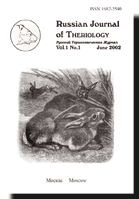
Russian Journal of Theriology
An international peer-reviewed journal published semiannually by the KMK Scientific Press Ltd. in English.
The Russian Journal of Theriology is the flagship publication of the Russian Theriological Society.
Aim and Scope
The Russian Journal of Theriology publishes papers on all aspects of mammalian biology: taxonomy, zoogeography, ecology, behavior, morphology, development, physiology, paleontology, and evolution. Studies of extinct as well as extant taxa are included. Reviews are also published; these may be invited by the Editorial Board.
Journal Ethics Statement
The Russian Journal of Theriology (RJT) complies with the basic ethical guidelines for scientific publications of the Committee on Publication Ethics (COPE) [www.publishingethics.org].
The authors and reviewers are kindly asked to refer to COPE documents and guidelines.
In particular, the duties of the RJT editorial board include taking a collegial decision of the publication of submitted articles, fair play in reviewing, providing confidentiality of the reviewing process, timely disclosure and taking account of any conflicts of interests in reviewing, full cooperation and involvement in case of any ethical complaints; reviewers contribute to editorial decision, provide prompt review or notify editors of impossibility (for any reason) to do it in time, maintain confidentiality of data related to the review and reviewed articles, follow standards of objectivity, identify relevant published sources not cited by the authors and substantial similarities with earlier published works, timely disclose any personal conflicts of interests related to authors of the reviewed articles, including competitive, collaborative, or other relevant relationships; the authors are obliged to comply with international reporting standards, provide access to raw data if needed, strictly avoid plagiarism and redundant publications, provide references to relevant published sources that influenced the submitted work, be directly responsible for authorship of the submitted manuscripts, identify possible hazards connected with methods used in the study, follow relevant (national and institutional) ethical regulations on animal and human studies, disclose any possible conflicts of interest that can influence the results, report found fundamental errors in published work in order to retract or correct the paper.
Abstracted and Indexed
Web of Science, SCOPUS, Scientific Electronic Library (eLIBRARY.RU), Zoological Record, Google Scholar
Founded in 2002.
2 issues per year. Approx. 150 pages per volume. 29.7 x 21 cm
Instructions to Authors
|
General comments
Russian Journal of Theriology accepts papers of short to moderate length (for papers exceeding 80 manuscript pages authors should consult editors before submitting). All submissions should be done electronically via the journal home page http://zmmu.msu.ru/rjt/. All pages should be numbered sequentially throughout. Leave the right margin without justification. Use only the Word editor working in Windows environment or convert text to DOC format. The text, references, figure captions, tables, and appendices, if present, should be placed in one file. Use Times New Roman font 12. Manuscripts that do not comply with the guidelines may be returned for corrections prior to review; in some cases, the manuscript may be edited by editors prior sending to reviewers. There are no obligatory page charges.
The Russian Journal of Theriology publishes in English. Authors whose first language is not English are urged to seek help from English-speaking colleagues before submitting the manuscript.
Generic, specific and subspecific names should be typed in italic.
Names of new taxa, synonyms, etc., should be followed thorough the text by sp. nov., gen. nov., syn. nov. given in bold.
Authors should strictly follow the last edition of the International Code of Zoological Nomenclature (1999). A species mentioned in the text for the first time must be supplied with the author(s) and year of publication. If the paper contains description of new species-group taxa, the author(s) should indicate the museum where types (type series) are deposited and provide the respective collection catalogue numbers of the type specimens.
For authors working in Russia the following institutions are preferable as depositories for type specimens: the Zoological Institute of the Russian Academy of Sciences and the Zoological Museum of the Moscow State University for extant species and Paleontological Institute of the Russian Academy of Sciences for fossils.
All DNA sequences should be placed in GenBank http://www.ncbi.nlm.nih.gov/ and accession numbers should be cited in the manuscript.
We recommend the following checklist as the taxonomic reference for extant mammals: D.E. Wilson & D.M. Reeder (editors). 2005. Mammal Species of the World. A Taxonomic and Geographic Reference (3rd ed.). Its online version is available at http://www.bucknell.edu/msw3/. Please check there the correct spelling of taxa, author names and dates before submission. The nomenclature of higher and extinct taxa can follow M.C. McKenna & S.K. Bell 1997. Classification of Mammals Above the Species Level. 631 pp. Columbia University Press, New York.
Russian personal and geographic names, except personal names with settled spelling, should be transliterated according to the following table.
Articles
The manuscript sent to the editors should be arranged as follows:
Title
Titles should be in capital and lowercase letters. A title should be as brief as possible but informative. Do not use terms or names which may not be known to most readers, for instance those introduced in the paper for the first time. Avoid abbreviated words and authorities and dates following taxonomic names.
Running title
Running title should not exceed 35 characters.
Name(s) of author(s)
Name(s) of authors(s) should start with the first name followed by abbreviated patronymic or second given name and the last name: Sergei P. Ivanov. Two author names should be separated by ampersand (&), three or more authors by comma and last author by ampersand. Indicate the corresponding author by the asterisk (*).
English abstract
The abstract should be informative, but not indicative; it should summarise the main facts, ideas, and conclusions of the article and should not exceed 250 words. Include all new taxonomic names introduced in the article. Abbreviations should be avoided. Citations of literature in the abstract are discouraged.
Key words in English
There should be 4-8 key words.
Address(es) of authors including electronic (e-mail) address
Provide authors’ names and addresses followed by electronic (e-mail) address in quadrate brackets []. Authors’ addresses should be separated by semicolon.
Name(s) of author(s) and title in Russian
Provide Russian names of authors and translation of the article title.
Russian abstract
Provide an exact translation of the English abstract. For authors whose native language is not the Russian, the Russian title and abstract will be prepared by the editors.
Key words in Russian
Provide exact translations of English key words.
Main part of the paper
The main text can be arranged according to purposes of the article, but a short Introduction section is required. The Introduction should be concise and intelligible to an inexperienced mammalogist. Use separate sections for materials, methods, results, discussion, conclusions. If abbreviations are used in the paper, they should be listed after the Introduction.
The diagnoses of new taxa should be explicitly differential.
Spell out single-digit whole numbers. Use numerals for numbers greater than nine.
When referring to a figure or a table in the text, follow the format "Fig. 1", "Fig. 2", "Tab. 1 " etc. When referring to several figures, use "Figs 1, 2".
Acknowledgements
Enlist all persons who helped in preparing the paper and all institutions and organisations that provided funding for your work. Do not forget in the final version to acknowledge reviewers even if they are anonymous.
References
Only provide references for the literature cited in the article. Only published works or those accepted for publication should be cited. Literature citations in the text should be given as: Smith (1975: 236-239), (Heptner, 1934: figs.1, 2), (Ognev, 1940a, b; Vinogradov & Gromov, 1984; Sokolov et al., 1994), the latter when the paper has three or more authors. The references should be arranged alphabetically, then by year of publication. Do not abbreviate journal names and give the editors' names of symposium volumes and edited books. Authors of taxa mentioned in the text do not need to be quoted in the References, if their papers are not cited. Transliterate names of Russian journals and publishers and translate (in square [] brackets) titles of Russian papers and books.
Example of a list of references:
Naumov R.L. 1974. [Ecology of alpine pika (Ochotona alpina) in Western Sayan] // Zoologicheskii Zhurnal. T.53. No.10. P.1524-1529 [in Russian, with English summary].
Gizenko A.I. & Schevchenko L.S. 1973. [Perspectives of breeding of the wild rabbit (Oryctolagus cuniculus L.) in Ukraine] // Vestnik Zoologii. No.4. P.10-15 [in Russian].
Argyropulo A.I. 1948. [Review of recent species of the family Lagomyidae Lilljeb., 1886 (Lagomorpha, Mammalia)] // Trudy Zoologicheskogo Instituta AN SSSR. T.7. P.124-128 [in Russian].
Dubrovo I.A. 1962. [Family Ursidae] // Gromova V.I. (ed.). [Fundamentals of Paleontology. Mammals]. Moskva: Gosudarstvennoe Nauchno-Tekhnicheskoe Izdatel'stvo Literatury po Geologii i Okhrane Nedr. P.214-218 [in Russian].
Zyll de Jong C.G., van. 1972. A systematic review of the Nearctic and Neotropical river otters (genus Lutra, Mustelidae, Carnivora) // Life Sciences Contribution, Royal Ontario Museum. Vol.80. P.1-104.
Gruzdev V.V. 1974. [Ecology of the Brown Hare]. Moskva: Izdatel’stvo Moskovskogo Gosudarstvennogo Universiteta. 162 p. [in Russian].
Storch G., Qiu Z. & Zashigin V.S. 1998. Fossil history of shrews in Asia // Wojcik J.M. & Wolsan M. (eds.). Evolution of Shrews. Białowieża: Mammal Research Institute, Polish Academy of Sciences. P.93-120.
Tables
Each table should be numbered with Arabic numerals and should start on a new page.
Figure captions
Begin figure captions on a new page.
Illustrations
Line drawings, maps, graphs and photographs must be produced and submitted electronically and be ready for publication. The illustration files must be saved in tiff format without compression using Grayscale mode and named “Figure” followed by the figure number (Figure_1, Figure_2 and so on). If a figure consists of several parts, they should be lettered in capital Roman letters (A, B, C, etc.), which should run consecutively from left to right and from top to bottom. The accepted sizes of the figure are 78 mm (one column) or 160 mm (two columns). The maximum height of the illustration is 240 mm. It is preferred that a figure leaves enough space on the same page to insert its caption. All illustrations must have resolution 300 dpi. Only black and white illustrations will be published in the printed version of the journal. The electronic (pdf) version of the journal can include color illustration. Such illustrations must be submitted additionally in tiff format without compression in RGB color mode.
Proofs
Authors will receive proofs. These must be returned within the time limit indicated. If this does not happen, the paper will be published as it is.
Reprints
Authors will receive a PDF reprint of the paper. |
Editorial Board
Editor-in-Chief:
Alexander O. Averianov
Associate Editors:
Alexei V. Abramov
Andrey A. Lissovsky
Alexey S. Tesakov
Leonid L. Voyta
Alexander E. Balakirev
Advisory Board:
Natalia I. Abramson (Zoological Institute RAS, Saint Petersburg, Russia); J. David Archibald (San Diego State University, San Diego, USA); Gennady F. Baryshnikov (Zoological Institute RAS, Saint Petersburg, Russia); Olaf R.P. Bininda-Emonds (Carl von Ossietzky University, Oldenburg, Germany); Vladimir N. Bolshakov (Institute of Ecology of Plants and Animals RAS, Ekaterinburg, Russia); Fedor N. Golenishchev (Zoological Institute RAS, Saint Petersburg, Russia); Zhigang Jiang (Institute of Zoology CAS, Beijing, China); Adrian M. Lister (Natural History Museum, London, United Kingdom); Alexei V. Lopatin (Paleontological Institute RAS, Moscow, Russia); Ryuichi Masuda (Hokkaido University, Japan); Igor Ya. Pavlinov (Zoological Museum of the Moscow State University, Moscow, Russia); Viatcheslav V. Rozhnov (A.N. Severtsov Institute of Ecology and Evolution RAS, Moscow, Russia); Nikolai G. Smirnov(Institute of Ecology of Plants and Animals RAS, Ekaterinburg, Russia); Alexei N. Tikhonov (Zoological Institute RAS, Saint Petersburg, Russia).
|

