期刊名称:ENVIRONMENTAL CHEMISTRY
|
ISSN: | 1448-2517
|
|
出版频率: | Bi-monthly
|
|
出版社: | CSIRO PUBLISHING, UNIPARK, BLDG 1, LEVEL 1, 195 WELLINGTON RD, LOCKED BAG 10, CLAYTON, AUSTRALIA, VIC, 3168
|
|
出版社网址: | http://www.publish.csiro.au/
|
|
期刊网址: | http://www.publish.csiro.au/nid/188.htm
|
|
影响因子: | 3.088 |
| 主题范畴: | CHEMISTRY, ANALYTICAL; ENVIRONMENTAL SCIENCES |
 期刊简介(About the journal)
投稿须知(Instructions to Authors)
编辑部信息(Editorial Board) 期刊简介(About the journal)
投稿须知(Instructions to Authors)
编辑部信息(Editorial Board)
About the journal
Scope
Environmental Chemistry publishes manuscripts addressing the chemistry of the environment (air, water, soil, sediments, space, and biota). The scope encompasses atmospheric chemistry, (bio)geochemistry, climate change, marine chemistry, water chemistry, polar chemistry, fire chemistry, astrochemistry, earth and geochemistry, soil and sediment chemistry and chemical toxicology. The journal aims to facilitate links between these aspects of environmental science, and thus papers that are multidisciplinary, and papers that view the environment as an integrated earth system, are particularly encouraged.
While focussing on the publication of important new original research and timely reviews, the journal also publishes essays and opinion pieces on issues of importance to environmental scientists, such as policy and funding.
Papers should be written in a style that is accessible to those outside the field, as the readership will include - in addition to chemists - biologists, toxicologists, soil scientists, and workers from government and industrial institutions. All manuscripts are rigorously peer-reviewed and professionally copy-edited.
The journal is published in print and online six times per year, online information being updated more frequently and containing information on papers in press.
Instructions to Authors
Notice to Authors
The Notice to Authors is also provided as a PDF file and may be viewed with Adobe Acrobat Reader. This software is free and can be installed from Adobe´s web site.
Licence to publish
For details regarding copyright, please see Copyright/Licence to Publish.
Return to Index
Open access
Authors may choose to publish their paper Open Access on payment of a publication fee. See Open Access for more details.
Return to Index
Scope and publishing policy
Environmental Chemistry publishes manuscripts addressing the chemistry of the environment (earth, water, atmosphere, biosphere), aiming to facilitate links between these often disparate aspects of environmental chemistry. Thus, papers that take an interdisciplinary approach, and those that advance our understanding of the environment as an integrated earth system, are particularly encouraged.
While focusing on the publication of important new original research and timely reviews, the journal also publishes essays and opinion pieces on issues of importance to environmental scientists, such as policy and funding. The publishing policy of Environmental Chemistry is to accept only those papers reporting important new chemistry with clear and significant implications for, or applications in, the environment (air, water, soil, sediments, space, and biota). Papers that report incremental results, which do not have sufficient originality and significance, will not be accepted for publication.
The journal is published in print and online six times per year, online information being updated more frequently and containing information on Papers in Press.
Return to Index
Submission of manuscripts - author´s overview
Please submit your manuscripts using our Online Submission and Peer Review system OSPREY, found at the journal´s homepage. Please include a covering letter that contains a justification for publication and a short text explaining in general terms (free of jargon) why the results are important to environmental science. The covering letter should also contain a statement that the manuscript has not been published or simultaneously submitted for publication elsewhere. A completed Licence to Publish form should accompany the manuscript. All manuscripts should include both an Environmental Context and an abstract.
Return to Index
Manuscript categories
Rapid Communications: Environmental Chemistry currently publishes a number of standard manuscript types. We suggest that authors submit manuscripts within the guidelines of these standards; however, we are willing to consider formats outside this range if good reasons are provided. For new results, we particularly encourage authors to submit Rapid Communications, as described below. Research Papers, Short Reviews, Highlights and Opinion Essays are regular features in the journal.
Rapid communications are short reports of preliminary research findings of exceptional importance and interest. A short abstract should be provided at the start of the manuscript. The text should ideally be no longer than 2000 words (but there is some flexibility). An introductory paragraph should provide a general context for the work, explaining its significance, and indicating why it should be of interest to environmental scientists in other areas. The paragraph should end by referring or alluding to the main findings of the work. The main part of the paper should present and discuss the results. The author may choose to end this discussion with some brief speculation and a comment on future directions. The final paragraph should summarise the major conclusions that can be drawn, and should point out how the work has advanced the field. Sufficient experimental details to support the conclusions must be included.
Research Papers: Research papers are complete reports of original research results that have not previously been published, except in the form of a preliminary communication (reprints or preprints should be provided on submission). A short abstract should be provided at the start of the manuscript. The paper should be divided into Introduction, Results and Discussion, Conclusion, and Experimental and/or Computational Methods sections. Research papers should be written as concisely as possible.
Short Reviews: Short Reviews should give a critical overview of a subject of high current interest, in which there have been important recent developments. Authors are encouraged to take a stance and lead the reader through the field. Overall a review should take us forward and show where a field is heading. The introduction should arouse the reader´s interest, describing the background, significance, and development of the field, and should be comprehensible to a broad audience. The main part of the review should be a comprehensive but critical analysis of recent (last three to five years) developments, current problems, and future directions. The review should conclude with a summary of the highlights (pointing out their significance) and unsolved problems. The manuscript should be 5000-8000 words in length and contain 10-15 graphics. A passport photo and a short biography (~100 words) should be submitted with the manuscript.
Return to Index
Highlights: Highlight articles present a few recent developments in a new, developing, controversial, or speculative field, and are intended to serve as an introduction and guide for the generalist reader. These articles can be controversial, but opposing viewpoints should - at least briefly - be presented. They should not be focused on the author´s own work. Language should be simple, novel concepts defined and specialist terminology explained. A short abstract should be provided at the start of the manuscript. A strong introduction describing the significance of and motivation behind the work should be followed by a clear and succinct presentation of important results, without the extensive technical details required for an original article nor extensive history required for a review. The conclusion should highlight the significance of the findings, and point to possible future directions. All of this should be presented in a manuscript of up to 2000-3000 words and three graphics.
Opinions: The Opinion Essay presents a novel perspective on a topical issue of current international concern. The author should be a recognised authority in the field. The author is welcome to take a controversial standpoint, but should make it clear that the argument is controversial, and should, at least briefly, refer to the generally accepted view for readers?information. Overall, the essay should provide a clear and balanced discussion to inform non-specialist readers about the issue and its new developments. It can make specific and practical proposals, either setting an agenda or proposing better alternatives. The length should be 800-900 words. Figures should be included where possible. A passport photo and a short biography (~100 words) should be submitted with the manuscript.
Return to Index
Manuscript preparation
Although we intend to adopt a flexible approach to matters such as format, the following items are strongly recommended.
Order: The sections of a manuscript should appear in the following order:
Title, Authors and Addresses, Environmental Context, Abstract
Introduction
Results and Discussion
Conclusion
Experimental and/or Computational Methods
References
The Experimental and/or Computational Methods section may, when necessary, appear in the body of the manuscript.
Return to Index
Line and page numbering: All lines and pages should be numbered for referees?reference.
Title: The title should be succinct and no longer than ten words. The title should capture important keywords.
Authors and addresses: The full names of all authors contributing to the work should be included, along with their complete postal addresses. Fax number(s) and email address(es) of the contact author(s) must be included. The addresses listed should be the institution(s) where the work was conducted; if this is different from the present address, this should be noted in a footnote. Authors of multi-authored papers may wish to assign relative values to their contributions, or to indicate that two or more authors contributed equally to a paper, which can be done in a note at the end of the address field on the paper.
Return to Index
Environmental context: The Environmental Context is a three-sentence paragraph written for interested non-experts, such as journalists, teachers, government workers, etc. The text should be written at the level of an article in a good newspaper. The purpose of the text is to convince readers of the significance of the work and your main motivation for doing it. Your first sentence should engage the reader, convincing them that this is an important area. The second sentence should introduce the problem addressed in the paper, and your main discovery. The final sentence should describe how the results fit into the bigger picture. Overall the Environmental Context should be free from scientific jargon.
Abstract: The Abstract should be 100-150 words. Authors should bear in mind that many more readers will see the abstract than will read the whole paper. It should give a brief rationale for the work, convey the paper´s main point, and outline the results or conclusions. It should end with one or two sentences that put the main findings into general context so it is clear how the results described in the paper have moved the field forwards.
Keywords: Up to five keywords should be provided, at least two being drawn from the core keyword list.
Text: Every manuscript should contain introductory and concluding paragraphs written in a general style that will allow the main points to be appreciated by a broad audience across the chemical, environmental, and biological sciences. A good rule is to use clear language that drives your story forward. Authors not fully fluent in the finer points of English are urged to consult native English-speaking colleagues before submitting manuscripts. Acronyms and less-common symbols should be defined on their first appearance or in an appendix; a selection of common abbreviations is provided. Chemical compounds should be labelled numerically, consecutively, and in bold face.
Return to Index
Introduction: This should provide a general context for the work, explaining its significance, and indicating why it should be of interest to scientists in other areas.
Conclusion: This should summarise the major conclusions that can be drawn, pointing out their significance, and alluding to possible future directions.
Experimental and/or Computational Methods and physical data: Procedures should be clearly documented and logically presented. Symbols should conform to the recommendations of the International Union of Pure and Applied Chemistry [see IUPAC´s recommendations in the Green Book (I. Mills, T. Cvitas, K. Homann, N. Kallay, K. Kuchitsu, Quantities, Units and Symbols in Physical Chemistry 2nd edn 1993 (Blackwell: Oxford)); e.g. s for second, m for metre, A for ampere, etc.]. Use SI data and negative indices (m s-1 rather than m/s). If other units must be used, their first appearance in a paper should be followed by a footnote or parenthesis giving the conversion factor.
Equations and mathematics: Equations should be numbered sequentially. Please avoid double sub- or superscripts. We recommend following the formats outlined in the Green Book (upright for constants (e, pi, i), italic for variables, bold italic for vectors and matrices).
Acknowledgements: As brief as possible, and to appear before the references.
Return to Index
References: Use the Vancouver style. In-text references are presented numerically, superscript in square brackets, after any punctuation. Citations should appear in numerical order throughout the text, consistent with the reference list at the end of the main text body. The reference list should also have reference numbers in square brackets. Initials are listed before surnames. The penultimate and final name in the list should be separated by a comma, the final name should be followed by a comma. Journal article titles should now be included after the final author name. The journal title should be italicised, followed by the year of publication in boldface, the volume number in italics, and the page number upright. Books follow the order authors - title - editors - year, volume, chapter, page - publisher. Computer programs, and patents follow essentially the same order with logical substitutions. Internal publications, conference proceedings, and web pages should be avoided. For example,[5,17-19]
[5] (a) L. Charlet, A. Manceau, Arsenic(III) Oxidation by Birnessite and Precipitation of Manganese(II) Arsenate, J. Coll. Interf. Sci. 1992, 148, 443.
(b) R. J. Spencer, N. Møller, J. H. Weare, The Prediction of Mineral Solubilities in Natural Waters, Geochim. Cosmochim. Acta 1999, 63, 1305.
[17] R. E. Williams, H. Peter-John, N. C. Bruce, C. R. Lowe, in Biosensors for Environmental Monitoring (Eds U. Bilitewski, A. P. F. Turner) 2000, pp. 213-215 (Harwood: Amsterdam).
[18] L. A. Marshall, K. E. Steiner, G. A. Schieser, U.S. Patent 4 889 858 1989.
Return to Index
Tables: Table numbers are designated by Arabic numerals. Tables consist of three horizontal rules, with headings centred over each column. Material in body of table is usually justified on the left-hand side. Numerical data are usually justified on the decimal point. Footnote references within tables are superscript capital letters, and footnotes appear at the bottom of the table, in the same size text as the body of the table.
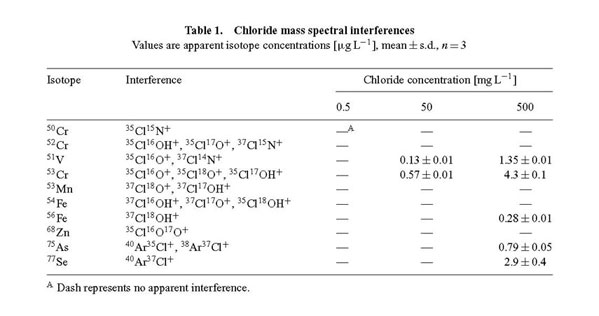 . .
Return to Index
Graphics: Figures and Schemes should be of sufficient quality to allow direct reproduction. Single-column (85 mm) width is preferred; double-column figures are acceptable where necessary. Numbers, letters, and symbols should be of the correct size to be 1.8 mm (8 pt) after reduction. Images with grey tones or colour should be provided as high-quality originals, and as electronic files in (ideally) TIFF, EPS, or PDF formats. For scanned photographs ensure the resolution is at least 300 dpi and for colour images use CMYK with the highest resolution possible. Image quality may be improved between the initial (for refereeing) and final (for publishing) manuscripts. For colour images in the print version, authors will be asked to help contribute towards the costs associated with colour printing.
Return to Index
Accessory publication: Material or data of a detailed nature, which is not essential in the printed paper but may be useful to other workers, may be lodged with the Editor if submitted with the manuscript for inspection by the referees. Such material will be made available from our website should the manuscript be accepted and a note to this effect should be included in the paper.
Return to Index
Submission of manuscripts
Initial submission
To submit your paper, please use the online journal management system OSPREY, which can be reached directly through this link or from the icon on the journal´s homepage. Choose Environmental Chemistry and use your existing user name and password to log in (first-time users, log in through the New User box). Choose ´Submit manuscript?from the menu on the left side of the screen and then follow the steps, providing the information requested under each step. A covering letter must accompany the submission and should include the name, address, fax and telephone numbers, and email address of the corresponding author. The letter should also contain a statement justifying why the work should be considered for publication in the journal, and that the manuscript has not been published or simultaneously submitted for publication elsewhere. Suggestions of possible referees are welcome. A completed Licence to Publish form (which you will be asked to download from the website as part of the submission process) should be faxed or mailed to the journal as soon as possible after submission. Authors are advised to read recent issues of the journal to note details of the scope of papers, headings, tables, illustrations, style, and general form. Observance of these and the following details will shorten the time between submission and publication. Poorly prepared and unnecessarily lengthy manuscripts have less chance of being accepted. If you encounter any difficulties, or you have any queries, please contact the Managing Editor.
Revised manuscript
Include a brief note of your responses to the referees?comments. Substantial changes should be highlighted. At this point the graphics can be properly drafted to publication standard.
Return to Index
Proofs: Proofs will be sent to the corresponding author(s).
Reprints: The corresponding author(s) will be sent a final PDF of their paper on publication.
Return to Index
Questions and correspondence
E-mail: Submission, assessment, and production matters:
publishing.env@csiro.au
Telephone: Submission and assessment matters:
Dr Alison Green +61 3 9662 7630
Dr Jenny Bennett +61 3 9662 7602
Address for submissions:
Manuscripts should be sent to publishing.env@csiro.au. If hard copy submission is preferred, then the same items should be sent, along with three hard copies to:
Managing Editor
Dr Alison Green
Environmental Chemistry
CSIRO PUBLISHING
PO Box 1139 (150 Oxford Street)
Collingwood, Vic. 3066
Australia
Editorial Board
Editorial Board
MembersMeet the Board
- Greg Ayers, CSIRO Atmospheric Research, Australia
- Graeme Batley, CSIRO Energy Technology, Australia
- Peter Brimblecombe, University of East Anglia, United Kingdom
- Peter Campbell, Québec University, Canada
- Greg Carmichael, University of Iowa, USA
- Terry Collins, Carnegie-Mellon University, USA
- Bill Davison, Lancaster University, UK
- Olivier Donard, Laboratoire de Chimie Analytique Bioinorganique et Environnement, CNRS, France
- Jörg Feldmann, University of Aberdeen, Scotland, UK
- Kevin Francesconi, Karl-Franzens University Graz, Austria
- Ole Hertel, National Environmental Research Institute, Denmark
- Keith Hunter, Otago University, New Zealand
- William Maher, University of Canberra, Australia
- Mike McLaughlin, CSIRO Land and Water, Australia
- Mario Molina, Massachusetts Institute of Technology, USA
- Simon Petrie, Australian National University, Australia
- F. Sherwood Rowland, University of California, Irvine, USA
- Shinsuke Tanabe, Ehime University, Japan
- Shizuo Tsunogai, Hokkaido University, Japan
- Kevin Wilkinson, University of Geneva, Switzerland
- Jonathan Williams, Max Planck Institute, Mainz, Germany
- Paul Worsfold, University of Plymouth, England
Managing Editor
Deputy Managing Editor
Editorial Contacts
Managing Editor - Alison Green
Alison´s current role is Chemistry Publisher and Editor of Environmental Chemistry and the Australian Journal of Chemistry - an International Journal for Chemical Science. She returned to Australia early in 2001 following two years as Associate Editor of Advanced Materials at Wiley-VCH in Germany. Prior to this she was an Alexander von Humboldt postdoctoral fellow in Marburg, Germany following a PhD in physical organic chemistry and BSc (Hons) in inorganic chemistry at the University of Melbourne, Australia. Her PhD thesis was awarded the Monica Reum Memorial Prize. Alison has been developing the idea of Environmental Chemistry since hearing a lecture on Atmospheric Problems of the 21st Century from F. Sherwood Rowland at the World Chemistry Congress in July 2001.
Managing Editor
Dr Alison Green
Environmental Chemistry
CSIRO PUBLISHING
PO Box 1139 (150 Oxford Street)
Collingwood, Vic. 3066
Australia
Telephone +61 3 9662 7630
Fax +61 3 9662 7611
Email publishing.env@csiro.au
Deputy Managing Editor - Jenny Bennett (née Cameron)
Jenny joined Environmental Chemistry in 2005. She has been in scientific publishing for 10 years, specifically as an editor for the Australian Journal of Chemistry - an International Journal for Chemical Science. Her PhD project at the University of Melbourne involved the synthesis and testing of some analogues of biologically important natural products.
Jenny assists the Managing Editor, Alison Green, by choosing referees, liaising with authors, and accepting revised manuscripts.
Deputy Managing Editor
Dr Jenny Bennett (née Cameron)
Environmental Chemistry
CSIRO PUBLISHING
PO Box 1139 (150 Oxford Street)
Collingwood, Vic. 3066
Australia
Telephone +61 3 9662 7602
Fax +61 3 9662 7611
Email publishing.env@csiro.au
Rights & Permissions
For all enquiries or requests regarding rights and permissions, please contact: publishing@csiro.au
|
|
 |
Major Sponsor |
|
|
Related Product |
|
|
|
|


