期刊名称:GLOBAL CHANGE BIOLOGY
 期刊简介(About the journal)
投稿须知(Instructions to Authors)
编辑部信息(Editorial Board) 期刊简介(About the journal)
投稿须知(Instructions to Authors)
编辑部信息(Editorial Board)
About the journal
|
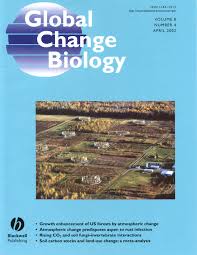
Global Change Biology exists to promote understanding of the interface between all aspects of current environmental change and biological systems, including rising tropospheric O3 and CO2 concentrations, climate change, loss of biodiversity, and eutrophication. Both biological responses and feedbacks to change are included, and may be considered at any level of organization from molecular to biome. Studies which integrate across levels of organization to provide a mechanistic understanding are particularly encouraged. Studies may be experimental, observational or theoretical, and may concern aquatic or terrestrial and managed or natural environments. GCB concentrates on primary research articles, but operates a flexible policy regarding other submissions, which include Technical Papers, Mini-Reviews and Opinion Articles.
Global Change Biology defines global change as any consistent trend in the environment - past, present or projected - that affects a substantial part of the globe. Examples include:
¡ì rising tropospheric ozone, carbon dioxide and sulphur dioxide concentrations
¡ì increasing UV-B irradiation
¡ì global climate change
¡ì biological sinks and sources of atmospheric trace gases
¡ì eutrophication
¡ì land use change
¡ì loss of biodiversity
¡ì biological feedback on climate change
¡ì biological mitigation for atmospheric change
The number of excellent manuscripts submitted to Global Change Biology has been increasing steadily - a testiment to the success of the journal. For the past four years it has been ranked consistently among the top three Environment Science journals listed by ISI, based on the journal Impact Factor. To maintain rapid publication, Global Change Biology will be published monthly from 2002. |
|
Instructions to Authors
General
Manuscripts may be submitted either in electronic form by email, or on paper by post. Electronic submission is preferable as it accelerates the peer review process. Manuscripts must be submitted exclusively to Global Change Biology and are accepted on the understanding that they have not been, nor will be, published elsewhere. If accepted, papers become the copyright of the Journal. Manuscripts should be accompanied by a Copyright Assignment Form in which all authors give signed consent to publication; permission to use published material elsewhere will be granted on request.
Editorial Office contact details:
Rebecca Heid
Editorial Assistant
Global Change Biology
University of Illinois
190 ERML
1201 W. Gregory Drive
Urbana, IL 61801-3838
USA
Tel. +1-217-333-9396 (8:30 a.m. - 12:00 noon local time only)
Fax +1-217-244-7563
E-mail: gcb@life.uiuc.edu
Manuscript submission by email
Global Change Biology is pleased to accept manuscript submission by email. Our submission procedure is very simple. You are asked to prepare your MS as a Microsoft Word file, complete a simple MS information form, and send the two files to the Editorial Office attached to an email message comprising the covering letter. We then convert the Word document to an Acrobat PDF file for peer review. Electronic submission accelerates the progress of the MS through the review process. The procedure consists of four simple steps:
1. Covering letter
Prepare an email message addressed to the Managing Editor. This letter should provide any information additional to that requested in the MS information form (see below), perhaps including aspects of the paper that you wish to highlight, suggestions for potential reviewers, requests for the exclusion of specific reviewers on conflict grounds, etc. If the MS is a resubmission of a previous MS, the covering letter MUST include full details of all changes made, keyed to the comments of the reviewers and Subject Editor of the original MS.
2. Manuscript File
Prepare your MS using Microsoft Word for the PC, or convert it to a form that can be read by Word for the PC. We cannot deal with unconverted Mac files, or with files created by non-standard word processing programs. [If your MS contains complex mathematical symbols not covered by standard versions of Word, please contact the Managing Editor for advice on submission.] Follow the standard Instructions to Authors for the preparation of manuscripts as outlined separately below. Embed all tables, figures and other graphic elements into a single Word file wherever possible - we do not wish to deal with multiple files for a single MS. Keep the file as small as possible, as files greater than 2-3 MB may be rejected by internet service providers - you may need to use low resolution figures in your Word file to keep this file size low enough. Give the file a sensible name (i.e., if the First Author is Darwin, the file name DarwinMS would be appropriate). Attach the file to the Covering Letter email message.
3. MS Information Form
Download the MS Information Form and carefully complete all parts. Name this file appropriately and attach to the Covering Letter email message.
4. Send email
Send the email message with the attachments to: gcb@life.uiuc.edu
Manuscript submission on paper
One (1) clear copy should be submitted, typed double-spaced on one side only with margins of at least 3 cm. The manuscript will be scanned and converted into an Acrobat pdf file for peer review. If manuscripts contain colour, or black/white photographs, five (5) copies of these must accompany the single copy of the manuscript. (This is to provide enough copies for despatch to referees and the editor, in cases where scanning of these elements is not feasible). Authors should retain copies of the manuscript and all associated material as the Editorial Office will not return these items.
Cover images
Global Change Biology uses images associated with published papers as covers for the journal. Authors are invited to submit candidate images, either with their manuscript or separately, preferably in electronic form, for consideration for the cover. Electronic files should be at a resolution of at least 300 d.p.i. at the final size for the cover. Authors should make sure the orientation of their candidate images is suitable for the space available on the front cover. Images should seek to be aesthetically pleasing and, wherever possible, to present a message related to the specific topic of the paper or the general coverage of the journal. Authors should submit a suitable brief caption to the image together with a photo-credit where appropriate. Images submitted as prints or transparencies will be returned to authors, if requested.
Preparation of manuscripts
Number all pages and, wherever possible, number the lines. The first text page should contain: Title; Full name of authors; Full postal address(es); Space for date of receipt; Six keywords for indexing purposes; Name, address, fax number and E-mail address of corresponding author, to whom proofs will be sent; Running title of no more than 45 characters, including spaces.
Primary Research Articles (maximum 8000 words)
Full papers reporting primary research should normally be structured as follows, starting each section on a separate sheet (number all pages consecutively, starting with 1 for the title page): Title page (as above); Abstract; Introduction; Materials and Methods; Results; Discussion; Conclusions (optional); Acknowledgements (optional); References; Tables; Figure Legends; Figures.
Short Communications (maximum 3000 words)
These should comprise no more than three displayed items (i.e. figures or table) and should follow the above format except that the Results and Discussion sections may be conflated if desired.
Other Articles
The above format may be varied for Mini-Reviews, Opinion Articles, Commentaries and Technical Advances. Mini-Reviews (i.e. articles treating a defined specialist subject that is of topical interest) are welcomed; they should normally be between 4000 and 8000 words in length. Opinion articles are speculative and provocative viewpoints, although they must be conditioned by the normal standards of scientific objectivity, and will be subject to peer review (maximum 4000 words). Commentaries are topical reports of developments relevant to global change (2000-3000 words). Technical Advances are intended to operate as rapid communications of significant technical developments, including new modelling approaches (maximum 4000 words).
All papers should be preceded by an informative Abstract, which should be restricted to 300 words for Full Papers, Reviews and Mini-Reviews, and 150 words for other papers.
Illustrations
On final submission of an accepted manuscript, always enclose a reproduction-quality hard copy of the figures - these will be scanned if your electronic artwork is not of the appropriate quality to use.
- Line drawings should be provided as laser printed copies at 600 d.p.i.
- Photographs (half-tones) should be original prints (i.e. not rephotographed) and suitable for reproduction. They should be unmounted with lettering clearly indicated on overlays or photocopies. For composites, photographs should be unmounted and a photocopy enclosed to indicate the required arrangement. Magnification should be given in the legend or indicated by a scale or bar.
Where possible, diagrams should be computer-generated and saved onto the submitted disk, preferably as TIFF (for images containing photographic information) or EPS (for line drawings) files. See our electronic artwork Standards for more details. We therefore recommend that authors generate their artwork in software packages incorporating a ¡®SAVE AS¡¯ or ¡®EXPORT¡¯ TIFF/EPS function, e.g.: Adobe Illustrator 7.0 and above (EPS), Adobe Illustrator 9.0 (EPS but can also export files as TIFF), Deneba Canvas 6.0 and above (EPS), CorelDRAW 7.0 and above (EPS), Adobe Photoshop 4.0 and above (TIFF). EPS files can be produced from other applications [e.g. PowerPoint, see electronic artwork Standards] BUT results can be unpredictable (e.g. fonts and shading not converted correctly, lines missing, dotted lines becoming solid). If you scan your images to create TIFF files, this should be performed at the appropriate resolution at the final size required e.g. for a line drawing at 800 d.p.i.
Colour reproduction. The journal welcomes colour photographs. The charges for inclusion of these in any one article are shown on the Colour Work Agreement form, which should be completed and returned with your accepted paper to the Editor for any papers containing colour images. Any colour image chosen for the front cover will be published free of charge.
References
References should follow the Harvard system and should be indicated in the text by surname of the author(s) with the year of publication. When there are more than two authors, use the first author followed by et al. The full list of references should be provided in alphabetic order, double-spaced at the end of the article, in the form of the following examples. Journal titles should be in full, not abbreviated. Where there are eight or more authors only the first three should be listed, followed by et al.
Lensen GM (1993) Response of C3 and C4 species from Dutch salt marshes to atmospheric CO2 enrichment. DS thesis, Vrije Universiteit, Amsterdam, 113 pp.
Halverson LJ, Clayton MK, Handelsman J (1993) Variable stability of antibiotic-resistance markers in Bacillus cereus UW85 in the soybean rhizosphere in the field. Molecular Ecology, 2, 65-78.
Lewis RL (1992) Satellite ocean color observations of global biogeochemical cycles. In: Primary Productivity and Biogeochemical Cycles in the Sea (eds Falkowski PG, Woodhead AD), pp. 139-154. Plenum Press, New York.
Graedel TE, Crutzen PJ (1993) Atmospheric Change: An Earth System Perspective. Freeman, Oxford, 446 pp.
Proofs
Proofs must be returned to the Production Editor within 3 days of receipt; fax should be used to facilitate communication. Authors should note that proof corrections should be marked as clearly as possible, and should be kept to a minimum. If the Editors consider that significant changes have been introduced at the proof stage, the right is reserved either to levy the costs to authors, or to request resubmission of the manuscript.
Offprints
Corresponding authors will receive 25 free reprints.
Editorial Board
Editor
Steve Long, University of Illinois, USA
Co-Founding Editor
Harry Smith FRS, Univerisity of Nottingham, UK
Subject Editors
Dennis Baldocchi, Ecosystem Science Division, University of California, Berkeley, CA, USA
Jeff Bale, Birmingham University, UK
Nina Buchmann, ETH Zurich, Switzerland
Eric Davidson, Woods Hole Research Center, USA
Richard Geider, University of Essex, UK
Hefin Jones, Cardiff University, UK
Beverly E. Law, Oregon State University, Corvallis, USA
Dennis Ojima, Colorado State University, CO, USA
Colin Prentice, Max Planck Institute for Biogeochemistry, Jena, Germany
J.I. Prosser, Molecular & Cell Biology, Institute of Medical Sciences, Aberdeen, AB25 2ZD, UK
Rowan F. Sage, University of Toronto, Canada
Osvaldo Sala, University of Buenos Aires, Argentina
Editorial Assistant
Rebecca Heid, Univerisity of Illinois, Urbana, USA
gcb@life.uiuc.edu
Editorial Board
Marilyn Ball, Ecosystems Research Group, School of Biological Science, Australian National University, Canberra ACT, Australia
Fakhri A Bazzaz, Organismic & Evolutionary Biology Department, Harvard University, The Biological Laboratories, 16 Divinity Avenue, Cambridge MA 02138, USA
W.C. Block, Terrestrial Freshwater Life Sciences, British Antarctic Survey, High Cross Madingley Road , Cambridge, CB3 0ET, UK
Gordon Bonan, Nat Ctr Atmospheric Research, Po Box 3000, Boulder, Colorado 80307-3000, USA
Sandra Brown, Senior Program Officer, Clean Energy Winrock International, 1621 North Kent Street Suite 1200, Arlington, Virginia 22209, USA
Doug Capone, Department of Biological Sciences, University of Southern California, Hancock Bldg Rm16 Wrigley Institute For Env Studies, Los Angeles , CA 90089-0371, USA
Bruce E. Chalker, Australian Institute Marine Science, Pmb No 3, Townsville, QLD 4810, Australia
James S. Clark, Department of Botany, Duke University, Durham, NC 27706, USA
Roger C. Dahlman, Office Health & Environmental Research, US Department of Energy, Washington DC, DC 20585, USA
B.G. Drake, Smithsonian Environ Research Centre, Contees Wharf Road P O Box 28, Edgewater, MD 21037, USA
Zvy Dubinski, Department of Life Sciences, Bar Ilan University, Ramat Gan, , Israel
Paul Falkowski, Institute Marine & Coastal Sciences, Rutgers University, 71 Dudley Road, New Brunswick, NJ 08901-8521, USA
Chris Field, Carnegie Institution, Department of Plant Biology, 260 Panama Street, Stanford, CA 94305, USA
Larry Flanagan, Department of Biological Sciences, University of Lethbridge, 4401 University Drive, Lethbridge, Alberta T1K 3M4, Canada
Inez Fung, School of Earth & Ocean Sciences, University of Victoria, Victoria BC, V8W 2Y2, Canada
Ilkka Hanski, Department of Zoology, University of Helsinki, Pl 17 P Rautatiekatu 13, Helsinki, FIN 00014, Finland
A. Henderson-Sellers, Environment Division, Nuclear Science & Technology Org, Private Mail Bag 1, Menai F47, NSW 2234, Australia
Tadaki Hirose, Biological Institute, Tohoku University, AOBA, Sendai 980, Japan
Patrick Holligan, Ocean & Earth Science, University of Southampton, Oceanography Centre European Way, Eastern Docks, Southampton, SO41 3ZH, UK
Paul Jarvis, Institute of Ecology & Resource Management, University of Edinburgh, Mayfield Road, Edinburgh, EH9 3JU, UK
R.L. Jefferies, Department of Botany, University of Toronto, s, M5S 3B2, Canada
Bruce A Kimball, USDA ARS, US Water Conservation Laboratory, 4331 E Broadway Road, Phoenix , AZ 85040, USA
Roger Knowles, Department Natural Resource Sciences, Mcgill University Macdonald Campus, St Anne De Belvoir, Quebec , H9X 3V9, Canada
C.H. Korner, Botanisches Institute Der Universität, Schonbeinstrasse 6, Basel CH -4056 , Switzerland
Beverly Law, 328 Richardson Hall, College of Forestry, Oregon State University, Corvallis, OR 97331-5752, USA
Jeffrey Levinton, Ecology & Evolution Department, State University New York Stony Brook, Upton , NY 11794, USA
Jon Lloyd, Max-Planck Institute F De, Erforschung, Sophienstrasse 10, Jena D-07743, Germany
Pamela Matson, Geological & Environmental Sciences, Stanford University, Green Building Room 355, Stanford , CA 94305-2115, USA
F. Miglietta, IATA-CNR, P.Le Delle Cascine 18 , Firenze I-50144, Italy
Hal Mooney, Department Botany, Stanford University, Stanford , CA 94305 , USA
J.C. Murrell, Department Biological Sciences, University of Warwick, , Coventry, CV4 7AL, UK
M.T.F. Piedade, Ins Nac De Pesquisas Amazonia, Inpa, Caixa Postal 478 Manaus , AM 69083, Brazil
Hugo H. Rogers, USDA-ARS, National Soil Dynamics Laboratory, Auburn , AI 36831, USA
David Schimel, National Center For Atmospherics, Po Box 3000, Boulder , Colorado 80307-3000, USA
R.J. Scholes, CSIR Division of Forest Science, P O Box 395, Pretoria 0001, South Africa
Ernst-Detlef Schulze, Max Planck Institute Of Biochemistry, Po Box 10 01 64 , Jena D-07701 , Germany
H.H. Shugart, Environmental Sciences, University of Virginia, Charlottesville, VA 22903, USA
Theodore J. Smayda, University of Rhode Island, Narragansett Marine Laboratory, Kingston, RI 02882-3711, USA
Keith A Smith, Institute Ecology & Resource Mngmt, University of Edinburgh, West Mains Road, Edinburgh, EH9 3JG, UK
Nigel E. Stork, Co-op. Research Centre for Tropical Rainforest Ecology & Management,, PO Box 6811, Cairns, QLD 6811, Australia
Masayuki Mac Takahashi, Department Biology, University of Tokyo, 3-8-1 Komaba Meguro-Ku, Tokyo 153, Japan
Max M. Tilzer, Aquatic Ecology, University of Constance, 25 Jacob-Burckhardt-Strasse, D-78464 Konstanz, Germany
Riccardo Valentini, Ist Zootecnia, Universit¨¤ degli Studi Della Tusca, Via De Lellis Snc, Viterbo I-001100 , Italy
Bess B. Ward, Geosciences Department, Princeton University, Guyot Hall, Princeton , NJ 08544, USA
John B. Whittaker, Department of Biological Sciences, Lancaster University, Bailreigg, Lancaster, LA1 4YQ, UK
F.I. Woodward, Department of Animal & Plant Science, University of Sheffield, Sheffield, S10 2TN, UK
Editorial Office contact details:
Rebecca Heid
Editorial Assistant
Global Change Biology
University of Illinois
190 ERML
1201 W. Gregory Drive
Urbana, IL 61801-3838
USA
Tel. +1-217-333-9396 (8:30 a.m. - 12:00 noon local time only)
Fax +1-217-244-7563
E-mail: gcb@life.uiuc.edu
|


