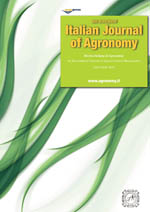
期刊名称:ITALIAN JOURNAL OF AGRONOMY

ISSN:1125-4718
出版频率:Quarterly
出版社:PAGEPRESS PUBL, MEDITGROUP, VIA G BELLI, 4, PAVIA, ITALY, 27100
  出版社网址:http://www.pagepress.org/
期刊网址:http://www.agronomy.it/index.php/agro
影响因子:2.3
主题范畴:AGRONOMY
变更情况:

期刊简介(About the journal)    投稿须知(Instructions to Authors)    编辑部信息(Editorial Board)   


About the journal

cover_agro

eISSN 2039-6805 

Focus and Scope

The Italian Journal of Agronomy (IJA) is the official journal of the Italian Society for Agronomy. It publishes quarterly original articles and reviews reporting experimental and theoretical contributions to agronomy and crop science, with main emphasis on original articles from Italy and countries having similar agricultural conditions. The journal deals with all aspects of Agricultural and Environmental Sciences, the interactions between cropping of sustainable development. Multidisciplinary articles that bridge agronomy with ecology, environmental and social sciences are also accepted.


Section Policies

Original Articles

Checked Open Submissions Checked Indexed Checked Peer Reviewed

Review Articles

Checked Open Submissions Checked Indexed Checked Peer Reviewed

Notes on experimental techniques and apparatus

Checked Open Submissions Checked Indexed Checked Peer Reviewed

Short communications

Checked Open Submissions Checked Indexed Checked Peer Reviewed

Letters to the Editor

Checked Open Submissions Checked Indexed Checked Peer Reviewed

LIFE+ ManFor C.BD

Unchecked Open Submissions Checked Indexed Unchecked Peer Reviewed
 

Peer Review Process

Our journal follows the CSE's White Paper on Promoting Integrity in Scientific Journal Publications about peer-review.

The Editorial Board of each journal will immediately screen all articles submitted for publication in that journal. Those articles which fail to reach the scientific standards of the journal may be declined without further review. Those articles which satisfy the requirements of the Editorial Board will be sent to a maximum of three referees. These are experts in the field who have agreed to provide a rapid assessment of the article. Every effort will be made to provide an editorial decision as to acceptance for publication within 4-6 weeks of submission. Referees may request a revision of the article to be made. In this case, it is generally understood that only one revised version can be considered for a further appraisal under the peer-review system. The Editorial Board of our journal is responsible for the final selection of referees to conduct the peer-review process for that journal. The names of referees will not be made available to authors. However, referees will be informed as to the identity of the authors whose articles are subject to review. All members of the Editorial Board and referees are asked to declare any competing interests they may have in reviewing a manuscript. If on receiving the editorial decision concerning their manuscript authors are not satisfied they are invited to appeal to the Editorial Office. In cases in which this is considered appropriate a second opinion on the manuscript will be requested.


Publication Frequency

All papers are published as soon as they have been accepted, by adding them to the "current" volume's Table of Contents.


Open Access Policy

This journal provides immediate open access to its content on the principle that making research freely available to the public supports a greater global exchange of knowledge.

Pre- and post-prints

PAGEPress allows and encourages authors to deposit both their pre- and post-prints in Open-Access institutional archives or repositories. The primary benefit of pre- and post-print self-archiving is reaching a larger audience which enhances the visibility and impact of your research.


Indexing

PAGEPress is currently working with the major databases and online resources, such as Pubmed/Medline, Pubmedcentral, Google Scholar, Directory of Open Access Journals (DOAJ), IndexCopernicus, Chemical Abstracts Service, OpenJ-Gate, Ulrich's Periodicals Directory, Sherpa/Romeo, Socolar, to track the Italian Journal of Agronomy articles. PAGEPress also have agreements with EBSCO Host, Elsevier Scopus, Bibliosan to track this Journal. PAGEPress is also working closely with Thomson Reuters (ISI) to ensure that citation analysis of articles published in this Journal will be available as soon as possible.


Publication Ethics

Editorship

PAGEPress strongly support the mission of the COPE Code of Conduct and Best Practice Guidelines for Journal Editors; all individuals collaborating with PAGEPress are strongly invited to comply with this mission.

Ethics

All research articles published by PAGEPress journals are subject to a rigorous ethical standards. Our journals endorses the Code of Conduct of the Committee on Publication Ethics (COPE), as well as the COPE International Standards for Editors and Authors Guidelines. The Editorial Board of each journal is responsible for the form the peer review process will take; therefore, all authors in the biomedical field must adhere to the Uniform Requirements for Manuscripts Submitted to Biomedical Journals. PAGEPress endorses the World Association of Medical Editors (WAME) Policy Statement on Geopolitical Intrusion on Editorial Decisions, too.

Plagiarism
The Editorial Board of our journals will immediately screen all articles submitted for publication in that journal. All submissions we receive are checked for plagiarism by using online available tools as eTBLASTor iThenticate®. Any suspected misconduct ends up with a quick rejection and is then reported to the European Science Foundation and to the US Office of Research Integrity.

The European Science Foundation released a Code of Conduct on Research Integrity, which is fully supported by our journals. All authors submitting papers to our journals are required to adopt these policies.

Below some online resource to help you in understanding plagiarism:

Roig, M. Avoiding plagiarism, self-plagiarism, and other questionable writing practices: A guide to ethical writing. St Johns University.

Long TC, Errami M, George AC, et al. Responding to Possible Plagiarism. Science 2009; 323:1293-1294.

Lewis J, Ossowski S, Hicks J, Errami M, and Garner HR. Text similarity: an alternative way to search MEDLINE. Bioinformatics 2006; 22:2298-2304.

Conflict of Interests

Conflict of interest exists when an author (or the author's institution), reviewer, or editor has financial or personal relationships that inappropriately influence (bias) his or her actions (such relationships are also known as dual commitments, competing interests, or competing loyalties). These relationships vary from negligible to great potential for influencing judgment. Not all relationships represent true conflict of interest. On the other hand, the potential for conflict of interest can exist regardless of whether an individual believes that the relationship affects his or her scientific judgment. Financial relationships (such as employment, consultancies, stock ownership, honoraria, and paid expert testimony) are the most easily identifiable conflicts of interest and the most likely to undermine the credibility of the journal, the authors, and of science itself. However, conflicts can occur for other reasons, such as personal relationships, academic competition, and intellectual passion.

All participants in the peer-review and publication process must disclose all relationships that could be viewed as potential conflicts of interest. Disclosure of such relationships is also important in connection with editorials and review articles, because it can be more difficult to detect bias in these types of publications than in reports of original research. Editors may use information disclosed in conflict-of-interest and financial-interest statements as a basis for editorial decisions.

When authors submit a manuscript, whether an article or a letter, they are responsible for disclosing all financial and personal relationships that might bias their work. To prevent ambiguity, authors must state explicitly whether potential conflicts do or do not exist. Authors should do so in the manuscript on a conflict-of-interest notification page, providing additional detail, if necessary, in a cover letter that accompanies the manuscript. Increasingly, individual studies receive funding from commercial firms, private foundations, and government. The conditions of this funding have the potential to bias and otherwise discredit the research.

Scientists have an ethical obligation to submit creditable research results for publication. Moreover, as the persons directly responsible for their work, researchers should not enter into agreements that interfere with their access to the data and their ability to analyze them independently, and to prepare and publish manuscripts. Authors should describe the role of the study sponsor, if any, in study design; collection, analysis, and interpretation of data; writing the report; and the decision to submit the report for publication. If the supporting source had no such involvement, the authors should so state. Biases potentially introduced when sponsors are directly involved in research are analogous to methodological biases.

Editors may request that authors of a study funded by an agency with a proprietary or financial interest in the outcome sign a statement, such as "I had full access to all of the data in this study and I take complete responsibility for the integrity of the data and the accuracy of the data analysis." Editors should be encouraged to review copies of the protocol and/or contracts associated with project-specific studies before accepting such studies for publication. Editors may choose not to consider an article if a sponsor has asserted control over the authors' right to publish.

Reviewers must disclose to editors any conflicts of interest that could bias their opinions of the manuscript, and they should recuse themselves from reviewing specific manuscripts if the potential for bias exists. As in the case of authors, silence on the part of reviewers concerning potential conflicts may mean either that conflicts exist and the reviewer has failed to disclose them or conflicts do not exist. Reviewers must therefore also be asked to state explicitly whether conflicts do or do not exist. Reviewers must not use knowledge of the work, before its publication, to further their own interests.

Editors who make final decisions about manuscripts must have no personal, professional, or financial involvement in any of the issues they might judge. Other members of the editorial staff, if they participate in editorial decisions, must provide editors with a current description of their financial interests (as they might relate to editorial judgments) and recuse themselves from any decisions in which a conflict of interest exists.

Protection of Human Subjects and Animals in Research

When reporting experiments on human subjects, authors should indicate whether the procedures followed were in accordance with the ethical standards of the responsible committee on human experimentation (institutional and national) and with the Helsinki Declaration of 1975, as revised in 2008. If doubt exists whether the research was conducted in accordance with the Helsinki Declaration, the authors must explain the rationale for their approach and demonstrate that the institutional review body explicitly approved the doubtful aspects of the study. When reporting experiments on animals, authors should indicate whether the institutional and national guide for the care and use of laboratory animals was followed.

See our policy about Peer Review

See our policy about Privacy


Instructions to Authors

Online Submissions

Already have a Username/Password for Italian Journal of Agronomy?
Go to Login

Need a Username/Password?
Go to Registration

Registration and login are required to submit items online and to check the status of current submissions.


Author Guidelines

To submit a paper to our journal:

  1. Register as an Author; we encourage you to register also as a reader and a reviewer at the same time.
  2. Follows the Instructions to authors below.
  3. Read our Editorial Policies and our Competing Interest policies

To submit a revised version:

  1. Log in
  2. Click on your role as Author
  3. Click on QUEUED FOR REVIEW on the page displayed
  4. Under the heading EDITOR DECISION, upload your revised paper as AUTHOR VERSION using Browse and Upload buttons
  5. Use the NOTIFY EDITOR email to inform editors that the revised version has been submitted


Instructions to Authors

Manuscripts must be written in British English. Authors whose native language is not English are strongly recommended to have their manuscript checked by a language editing service, or by an English mother-tongue colleague prior to submission.

Manuscripts should be saved and submitted as a single WORD file containing the full text, references, tables and figures. In case of acceptance, original text and figures must be provided for publication.

Original Articles should normally be divided into an abstract, introduction, design and methods, results, discussion and references. The abstract should contain a maximum of 400 words. A maximum of 20 authors is permitted, and additional authors should be listed in an ad hoc appendix. Review Articles: no particular format is required for these articles. However, they should have an informative, unstructured abstract of about 250 words. Reviews may also include meta-analyses, guidelines and consensus papers by scientific societies or working groups. These studies must be conducted following proper, widely accepted ad hoc procedures. Short Communications are articles with a simple layout and containing limited data (no more than two figures or tables) and a small number of citations (not more than 25). They should be limited to 2,000 words of text (figure captions, table headings and reference lists are additional to this limit). Letters to the editor should be from 250 to 1,000 words in length. Authors of letters to the editor should provide a short title for their letter.

Style

The manuscripts should be double spaced with numbered lines and wide margins and

should be arranged as follows.

Title page: including the full title, the name(s) of the author(s), their affiliation and the name of the corresponding author to whom proofs and requests for off-prints should be sent. Abstract: should not exceed 400 words. Keywords: three to six keywords characterizing the content of the article in alphabetical order. Introduction. A brief introduction. Materials and methods: this section should provide sufficient information and references on the techniques adopted to permit their replication. Results: the content of this section should permit full comprehension of the data reported in figures and tables. Discussion: this should underline the significance of the results and place them in the context of previous research. Acknowledgements.


References should be prepared strictly according to the instructions given below.

Units: authors are recommended to use the International System of Units (SI).


Scientific names: common names of organisms should always be accompanied, when first cited, by their complete scientific name in italics (genus, species, attribution and, if appropriate, cultivar).


Formulae: mathematical formulae must be carefully typed, possibly using the equation editor of Microsoft Word; when a paper contains several equations they should be identified with a number in parentheses (e.g. Eq. 1). Please note that each accepted paper will undergo technical and scientific copyediting before publication.


Tables: t

ables are numbered consecutively in Arabic numbers without “no.” before the number. References should be made in the text to each table. The desired style of presentation can be found in published articles.

Titles of tables should be descriptive enough to be able to stand alone. Do not present the same data in tabular and graphic form.


Figures:  f

igures are numbered consecutively in Arabic numbers. References should be made in the text to each figure. Each figure should have a caption. The term "figure" is used also for graphs and photos.
 Symbols and abbreviations used in figures can be defined in the figure caption or note or within the figure itself.

Please avoid the use of bold face or greater size for the characters. Symbols and abbreviations used in figures can be defined in the figure caption or note or within the figure itself.


The figures must be submitted as .tif or .jpg files, with the following digital resolution:


1. Color (saved as CMYK): minimum 300 dpi


2. Black and white/grays: minimum 600 dpi

Lettering of figures must be clearly labelled.


Movies

Movies can be submitted and uploaded as "Supplementary Files" during the manuscript submission procedure. Dimension should not exceed 5 MB.


Citations in the text:

The Journal follows the "author, year" style of citation.

When a citation has one or two authors, cite the reference throughout using the name(s) and the date.

When a citation has more than two authors, cite the reference throughout the text with et al. following the last name of the first author.

When two or more references are included in a grouping within a sentence, they are arranged and separated by a semicolon.

The first criterion is the year (former citations precede recent ones); multiple citations for a given year are further arranged alphabetically and multiple citations for the same initial letter are arranged as follows: first the citation with one author, secondly the citation with two authors, then the other (with et al.).

When the same author has two references with different dates, cite them in chronological order, separating the dates with a comma; when the same author has two references with the same date, arrange the dates as a and b (also in the reference list) and separated by a comma.

Journal titles mentioned in the reference list should be abbreviated according to the following websites (sequenced by relevance):

1. ISI Journal Abbreviations Index

(http://library.caltech.edu/reference/abbreviations/)


2. Biological Journals and Abbreviations

(http://home.ncifcrf.gov/research/bja/)


Example: (Foury, 1967, 1972; Burns et al., 1970; Allen et al., 1990; Basnizki and Zohary, 1994; White et al., 1990a,b).


Citation should be made in the text to each reference.

Citations are listed in strict alphabetical order by first author' last names.

Use capital and lower case letters for authors' names

.


If all authors are identical for two or more citations, chronological order of publication should dictate the order of citations. When more than one paper in a given year is listed by authors whose names are in the same order in each paper, the papers are arranged in alphabetical order of the paper title.


Use the following system to arrange your references:


1.  periodicals:

Hennighausen LG, Sippel AE, 1982. Characterization and cloning of the mRNAs specific for the lactating mouse mammary gland. Eur. J. Biochem. 125:131-41.


2. books:

National Research Council, 2001. Nutrient Requirements of Dairy Cattle. 7th rev. ed. National Academy Press, Washington, DC, USA.


3. multi-authors books:

Brouwer I, 1965. Report of the sub-committee on constants and factors. In: K.L. Blaxter (ed.) Energy metabolism. EAAP Publ. N. 11, Academic Press Ltd., London, UK, pp 441-3.


4.  proceedings:

Rossi A, Bianchi B, 1998. How writing the references. Proc. 4th World Congr. Appl. Livest. Prod., Armidale, Australia, 26:44-6. (Or 44, if one page) -

Blanco P, Nigro B, 1970. Not numbered volumes. Page 127 (or pp 12-18) in Proc. 3rd Int. Conf. Cattle Dis., Philadelphia, PA, USA.


5. thesis:

Rossi P, 1999. Stima di parametri genetici nella razza Reggiana. Degree Diss., Università di Milano, Italy.


6. material from a World Wide Web site:

Food and Drug Administration, 2001. Available from: http://www.fda.gov


7.  in press:

Manuscripts that have been accepted for publication but are not yet published can be listed in the literature cited with the designation (In press) following the journal title.


8. other:

Citations such as personal communication, unpublished data, etc. should be incorporated in the text and NOT placed into the Reference section.


Peer-review policy: 

All manuscript submitted to our journals are critically assessed by external and/or inhouse experts in accordance with the principles of Peer Review, which is fundamental to the scientific publication process and the dissemination of sound science. Each paper is first assigned by the Editors to an appropriate Associate Editor who has knowledge of the field discussed in the manuscript. The first step of manuscript selection takes place entirely inhouse and has two major objectives: a) to establish the article's appropriateness for our journals' readership; b) to define the manuscript's priority ranking relative to other manuscripts under consideration, since the number of papers that the journal receives is much greater than that it can publish. If a manuscript does not receive a sufficiently high priority score to warrant publication, the editors will proceed to a quick rejection. The remaining articles are reviewed by at least two different external referees (second step or classical peer-review).

Authorship. All persons designated as authors should qualify for authorship according to the CSE' criteria (http://www.councilscienceeditors.org/i4a/pages/index.cfm?pageid=3355) Each author should have participated sufficiently in the work to take public responsibility for the content. Authorship credit should be based only on substantial contributions to (a) conception and design, or analysis and interpretation of data; and to (b) drafting the article or revising it critically for important intellectual content; and on (c) final approval of the version to be published. These three conditions must all be met. Participation solely in the acquisition of funding or the collection of data does not justify authorship. General supervision of the research group is not sufficient for authorship. Any part of an article critical to its main conclusions must be the responsibility of at least one author. Authors should provide a brief description of their individual contributions.



Submission Preparation Checklist

As part of the submission process, authors are required to check off their submission's compliance with all of the following items, and submissions may be returned to authors that do not adhere to these guidelines.

  1. The submission has not been previously published, nor is it before another journal for consideration (or an explanation has been provided in Comments to the Editor).
  2. The text is double-spaced; uses a 12-point font; employs italics, rather than underlining; and all illustrations, figures, and tables must be placed at the end of the document. The submission file is saved as a single WORD document containing full text, tables and figures.
  3. This journal charges a fee for publication. Please confirm that you will pay the amount due when the manuscript is accepted for publication.
  4. The text adheres to the stylistic and bibliographic requirements outlined in the Author Guidelines, which is found in About the Journal.
  5. Authors are kindly required to suggest at least two potential reviewers (name, affiliation and e-mail) for their manuscript in the "Comments to the Editor" field (Step 1. Submission Process).
 

Copyright Notice

PAGEPress has chosen to apply the Creative Commons Attribution NonCommercial 4.0 International License (CC BY-NC 4.0) to all manuscripts to be published. 

An Open Access Publication is one that meets the following two conditions:

1. The author(s) and copyright holder(s) grant(s) to all users a free, irrevocable, worldwide, perpetual right of access to, and a license to copy, use, distribute, transmit and display the work publicly and to make and distribute derivative works, in any digital medium for any responsible purpose, subject to proper attribution of authorship, as well as the right to make small numbers of printed copies for their personal use.
2. A complete version of the work and all supplemental materials, including a copy of the permission as stated above, in a suitable standard electronic format is deposited immediately upon initial publication in at least one online repository that is supported by an academic institution, scholarly society, government agency, or other well-established organization that seeks to enable open access, unrestricted distribution, interoperability, and long-term archiving.

Authors who publish with this journal agree to the following terms: 1. Authors retain copyright and grant the journal right of first publication with the work simultaneously licensed under a Creative Commons Attribution License that allows others to share the work with an acknowledgement of the work's authorship and initial publication in this journal. 2. Authors are able to enter into separate, additional contractual arrangements for the non-exclusive distribution of the journal's published version of the work (e.g., post it to an institutional repository or publish it in a book), with an acknowledgement of its initial publication in this journal. 3. Authors are permitted and encouraged to post their work online (e.g., in institutional repositories or on their website) prior to and during the submission process, as it can lead to productive exchanges, as well as earlier and greater citation of published work.


Privacy Statement

Privacy is an important concern for users of our site and is something that PAGEPress takes very seriously. Below you will find our policy for protecting users' personal information. Registration on our website is optional and voluntary. Browsing and viewing articles on our website does not require any personal information to be submitted from users. Nor do these functions require the user's browser to be set to accept cookies. Some other services published on our website do require the use of cookies and information such as name, e-mail, etc. This is necessary for security reasons and to enable us to be able to assure standards of scientific integrity. Users may submit further personal information (e.g. details of research areas of interest) in order to take advantage of present and future personalization facilities on our website. In accordance with European Union guidelines, registrants may decline to provide the information requested. They should be advised, however, that PAGEPress may be unable to deliver its services unless at least the information necessary for security and identification purposes is provided. In order to offer the best possible service to users, PAGE Press tracks the patterns of usage of pages on the site. This enables us to identify the most popular articles and services. Where users have provided details of their research areas of interest, this information can be linked to them, helping PAGEPress to offer scientists, the most relevant information based on their areas of interest. User information will only be shared with third parties with the explicit consent of the user. Publishing a scientific manuscript is inherently a public (as opposed to anonymous) process. The name and e-mail address of all authors of a PAGEPress manuscript will be available to users of PAGEPress. These details are made available in this way purely to facilitate scientific communication. Collecting these e-mail addresses for commercial use is not allowed, nor will PAGEPress itself send unsolicited e-mails to authors, unless it directly concerns the paper they have published on PAGEPress journals. PAGEPress reserves the right to disclose members' personal information if required to do so by law, or in the good faith and belief that such action is reasonably necessary to comply with a legal process, respond to claims, or protect the rights, property or safety of PAGEPress, employees or members.


Editorial Board

Editorial Team

Managing Editor

Production Editors

  1. Ms. Cristiana Poggi, PAGEPress Office, Pavia, Italy
  2. Ms. Claudia Castellano, PAGEPress Office, Pavia, Italy

Technical Support

  1. Mr. Tiziano Taccini, PAGEPress Office, Pavia, Italy

Copyright © 2014 武汉大学图书馆 版权所有