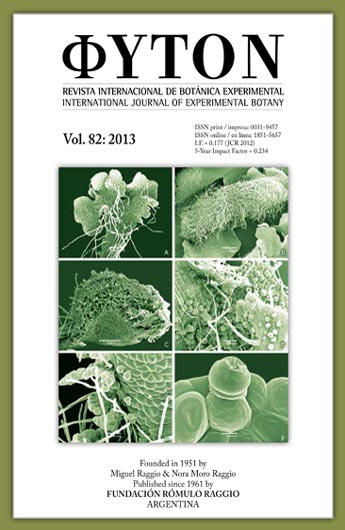
This Journal publishes original articles, short and technical notes and review articles in all fields of botany, and the biology of soils or terrestrial and aquatic plants.
Manuscripts reporting results of descriptive, historical and experimental studies on any aspect of botany, and soil or plant biology, and at the scale of organism, population, community, ecosystem and landscape are solicited, as well as manuscripts on ecological theory.
Phyton, International Journal of Experimental Botany also publishes Symposium proceedings, thesis and comments on recent papers in the journal.
Manuscripts can be written either in English or Spanish.
Impact Factor (2012) : 0.177. Issues per year: 1
5-Year Impact Factor : 0.234.
Authors should have manuscripts thoroughly reviewed by colleagues regarding both technical content and English or Spanish grammar in their own Institution and elsewhere before submitting them. It is not the task of the Executive Editor, Associate Editors or Journal reviewers to edit poorly prepared papers or to correct readily detectable errors.
Papers not properly prepared will be returned to the author.
Therefore, we ask all those who submit articles for publication consideration in the Journal (starting January 2009) to provide potential photos to be included in the front cover; a description of the photo and the author/s (which must be provided by the author/s) will be included at the back of the front cover.
One photograph will be selected each year for the front cover of the volume of that year among the total received during that year.
We thank the authors for their contributions.
-Manuscript Submission and Correspondence
Manuscripts should be submitted via e-mail to the
Executive Editor – Phyton ,International Journal of Experimental Botany:
Dr. Carlos A. Busso
cebusso@criba.edu.ar
carlosbusso1@gmail.com
with copy to the
Managing Editor
Alejandra K. de Raggio
Fundación Rómulo Raggio,
Gaspar Campos 861,
1638 Vicente López, Buenos Aires,
Argentina
Tel +54 11 4796 1456 / Tel Fax +54 11 4791 0868
fund_r_raggio@hotmail.com
revistaphyton@fund-romuloraggio.org.ar
Copies must be sent via email including tables and/or figures. Also, electronic copies of Tables and Figures on CD must also be sent when they are too huge for being sent via email to both the Managing and Executive Editors:
Dr. Carlos A. Busso
Cumeruca 376
Barrio Patagonia
8000-Bahía Blanca
Provincia de Buenos Aires.
Argentina
Receipt of manuscripts will always be confirmed.
Submission of manuscripts for publication consideration implies the acceptance of all the conditions included in these instructions for authors.
The name, address, telephone, fax number and e-mail of the author responsible for correspondence, reprints, etc. should be sent in the cover letter. Manuscripts are reviewed by members of the Editorial Board, appropriate referees, and the Executive Editor. The final decision to accept or reject a manuscript is made by the Executive Editor, who will inform authors on acceptance, revision, or rejection of manuscripts. Associate Editors will ask the reviewers to make the revision within a month. If the reviewer is unable to make the revision in such a period, He/She should report immediately to the Associate Editor about this inconvenient. If this is the case, the Associate Editor will choose another reviewer able to make the revision within a 30-day-period. Authors will also have to complete the revision within a 3-month-period. Otherwise, the manuscript will be released to the authors, and the submission to Phyton, International Journal of Experimental Botany will be considered terminated. Revised manuscripts should be submitted via e-mail to the e-mail addresses indicated above.
Periodicity of this Journal is one volume per year, released in December every year. All correspondence concerning submitted manuscripts should refer to the manuscript number and should be sent via e-mail to the Executive and Managerial Editors.
If the author handling correspondence changes address, the Executive and Managerial Editors should be notified immediately.

-Manuscript preparation
All parts of the manuscripts, including tables and figure legends must be typed and double-spaced throughout on one side,
wide margins on A4 white paper.
Arrange components in the following order:
Title
Abstract (not exceeding 300 words)
Introduction
Material and Methods
Results
Discussion
Acknowledgements
References
Tables in numerical sequence
Figure Legends
Figures
Begin each component on a separate page. Number all pages consecutively starting with the title page.
TITLE PAGE
The title page should contain the following:
1- Main title (lowercase letters)
2- Authors listed in the order in which they are to appear and affiliation(s)
3- Institutional addresses
4- Running title (not exceeding 50 characters including punctuation and spaces)
5- Total number of figures graphs, tables or plates
6- Mailing address and e-mail of the senior author
7- Footnotes
8- The operating system and word processor used to prepare the manuscript.
ARRANGEMENT OF THE MANUSCRIPT
The manuscript must be arranged as follows:
1-Title. The title should be brief, specific and should not include abbreviations. It cannot exceed 100 characters, including spaces.
It must always be submitted in both English and Spanish.
2-Abstract. Submit an abstract (300-word maximum) of the manuscript which must include a statement of the problem, methods of study, results and conclusions. It must always be submitted on a separate sheet in both English and Spanish.
Keywords must always be submitted right after each abstract in both English and Spanish.
3-Introduction. State concisely the purpose and rationale for the study.
4-Material and Methods. Describe in sufficient detail (to permit other workers to repeat the study) the plan, the experimental species, material and controls, the methods and procedures utilized and the statistical method(s) employed.
5-Results. Present the detailed findings. Include mentions of all tables and/or figures. Figures and tables should supplement, not duplicate, the text. Emphasize only your important observations. Do not compare your observations with those of others. Such comparisons and comments are reserved for the Discussion section.
6-Discussion. Must be restricted to the analysis and interpretation of the meaning of the statistically significant results and their relation with other papers.
7-Acknowledgments.
8-References. References to articles and books should be limited to published work, work in press, or theses and dissertations.
When citing more than two authors in the text, please specify the last name of the first author followed by et al.
Citations in the text should use the following forms:
Jones (1990)
Smith y Jones (1992)
o (Smith et al., 1991).
Si los manuscritos están escritos en inglés, “y” debe ser reemplazado por el símbolo “&” en todas las citas y referencias (ver Instructions for Authors). Las referencias deberán ser listadas en orden alfabético. Los nombres de revistas, en itálica, no deberán estar abreviados. Revisar el manuscrito para asegurarse que todas las referencias en el texto están incluidas en la sección Referencias.
También se debe revisar para asegurarse que todas las citas tienen el formato correcto.
Briske, D.D. y J.H. Richards (1995). Plant responses to defoliation: A physiological, morphological and demographic evaluation. En: Bedunah, D.J. and Sosebee, R.E. (eds), pp. 635-710. Wildland Plants. Physiological Ecology and Developmental Morphology. Society for Range Management, Denver, Colorado, USA. 710 p.
Jones, H.G. (1992).Plants and microclimate. A quantitative approach to environmental plant physiology. University Press, Cambridge.428 p.
Howe, H.F. y J. Smallwood (1982) Ecology of Seed Dispersal. Annual Review of Ecology and Systematics 13: 201-228.
Saint Pierre, C., C.A. Busso, O.A. Montenegro, G.D. Rodríguez, H.D. Giorgetti, T. Montani y O.A. Bravo (2004). Defoliation tolerance and ammonium uptake rate in perennial tussock grasses. Journal of Range Management 57: 82-88.
Flemmer, A.C., C.A.Busso, T. Montani,, O.A. Fernández, C. Saint Pierre y M.L. García (1999). Growth of S. gynerioides in competition with defoliated or undefoliated desirable perennial grasses under different levels of soil water availability. People and Rangelands Building the Future, Proceedings of the VI International Rangeland Congress, Eldridge, D. & Freudenberger, D. (Eds.), Townsville, Australia, p. 248-249.
Lencinas, M.V., G.M. Pastur, E. Gallo, A. Moretto, C.A. Busso y P. Peri (2006). Mitigation of biodiversity losses in Nothofagus pumilio managed forests of South Patagonia. Workshop on Forest Fragmentation in South America, San Carlos de Bariloche, Argentina, in CD.
Busso, C.A., M. Mazzola, B.L. Perryman y H.A. Glimp (2004). Seed weight and its relationship to environmental variables and germination in Artemisia tridentata ssp. wyomingensis. International Conference of the Society for Ecological Restoration, August 24-26, University of Victoria, Victoria, British Columbia, Canadá. p 18 Leyendas de las figuras. Las leyendas deben ser escritas en hojas separadas en español e inglés; deben contener una corta descripción y, cuando corresponda, indicar el grado de amplificación de las microfotografías electrónicas y ópticas.Ejemplo: (x 20.000).
If manuscripts are written in Spanish, the symbol “&” must be replaced by “y” anywhere in the manuscript (see Instrucciones para autores).
References should be listed in alphabetical order. Names of journals should not be abbreviated.
Check the manuscript to make sure that all references are cited and that all citations in the text are included in the References. Also check to make sure that all citations have the correct format.
9-Legends of the Figures
Legends must be typed on separate sheets in both English and Spanish; they must contain a short description and the enlargement of optical and electron micrographs. Example: (X 20,000)
UNITS OF MEASURE
Use the International Unit System throughout the text. Details on such units can be found on the web page of the Canadian Journal of Plant Science. Please use, for example, kg/ha, kg/ha/day, kg/m2, mg/l, tillers/plant, cm/cm3, oC, p<0.05 rather than using kg ha-1, kg ha-1 day-1, kg m-2, mg l-1, tillers plant-1, cm cm-3, C, P<0.05. When using measurement units, always utilize lowercase letters.
TABLES AND FIGURES
Make tables and figures self-contained and self-explanatory. They should supplement, not duplicate the text. A brief title for each table or figure should be provided in both English and Spanish. The explanations of the measures and statistics employed must be explained in footnotes to the table. Symbols and physical units must be subjected to the International System (I.S.) of abbreviations.
Color Tables and Figures will be included in the online and .pdf versions, but only in black and white in the printed version.
For best reproduction, electronic artwork files must be in TIFF, EPS or JPG format, at a resolution of 300 dpi, sized to print in color version.
BRIEF NOTES
They are welcome only if the results in the paper provide a new or unique contribution of immediate importance. They are to consist of either (1) no more than 1200 words, one table or graph and one plate of photographs. They must fulfill the instructions for original articles and may or may not have subtitle/s, or (2) not more than 5000 words, and tables and/or graphs. They must follow the instructions for original articles and include their sections (i.e., Abstract, Introduction, Materials & Methods, Results, Discussion and References).
PAGE CHARGES AND REPRINTS
Authors will be charged U$S 60 per printed page plus U$S 60 for handling costs, once their paper is accepted for publication. Authors will receive a .pdf file of their article and the volume where their article has been published. Prints should be specially requested and will be charged according to current fees. Papers accepted for publication become copyright of Phyton, International Journal of Experimental Botany.
NOMENCLATURE/ ACKNOWLEDGMENTS AND DEDICATIONS
The basis for the Nomenclature of taxa and syntaxa used should be indicated in the Methods section as should the latitude and longitude of the study site(s), if appropriate. Acknowledgments and dedications must be placed after the Main text and before the References.
APPENDICES
Information too detailed to be included in the main text, for instance a list of areas sampled or technical details of a model may be presented in appendices. Appendices should be numbered sequentially and placed before the References.
SCIENTIFIC NAMES
Scientific names of genera and species must be given in full with authority when they are cited for the first time. If species names occur repeatedly in the text the genus name may be abbreviated. Common names must not be used.
FORMULAE
Formulae should be presented in the text. Complicated formulae should be collected and presented as a figure in camera−ready appearance. Mathematical derivations should be kept to a minimum and put in an appendix.
ITALICS
Italics should be used for secondary headings, scientific names of taxa (genus and lower) and syntaxa, algebraic expressions and symbols in formulae.
PAGE PROOFS
Page proofs are sent to the author(s) together with the manuscript. The corrected proofs, together with the manuscript, should be returned to the Managing Editor, Alejandra K. de Raggio, without delay.