图书馆主页
数据库简介
最新动态
联系我们


返回首页


字顺( Alphabetical List of Journals):

A|B|C|D|E|F|G|H|I|J|K|L|M|N|O|P|Q|R|S|T|U|V|W|X|Y|Z|ALL


检 索:        高级检索

期刊名称:EDUCATION AND TREATMENT OF CHILDREN

ISSN:0748-8491
出版频率:Quarterly
出版社:SPRINGERNATURE, CAMPUS, 4 CRINAN ST, LONDON, ENGLAND, N1 9XW
  出版社网址:http://wvupressonline.com/
期刊网址:http://wvupressonline.com/journals/etc
影响因子: 1.491 (2020年) 0.898(2018年) 0.780(2017年) 0.571(2016年) 0.485(2015年) 0.773(2014年)
主题范畴:EDUCATION, SPECIAL;    REHABILITATION
变更情况:Newly Added by 2014

期刊简介(About the journal)    投稿须知(Instructions to Authors)    编辑部信息(Editorial Board)   


About the journal

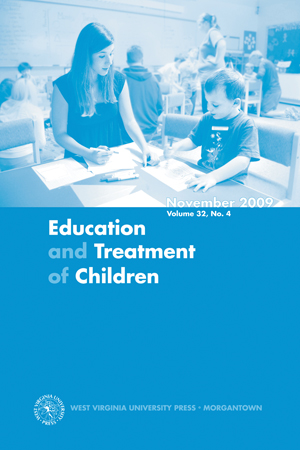
Education and Treatment of Children

Editor: Dr. Bernie Fabry
E-ISSN: 0748-8491
Frequency: Quarterly

Education and Treatment of Children is an important journal for researchers, educators, and clinical practitioners, as well as graduate students and others with a professional interest in the development of children and youth and a mission to improve teaching, training, and treatment effectiveness. The contents include experimental studies, literature reviews, data-based case studies, and book reviews. Education and Treatment of Children (ETC) is devoted to the dissemination of information concerning the development of services for children and youth. A primary criterion for publication is that material be of direct value to educators and other child care professionals in improving their teaching/training effectiveness.


Instructions to Authors

Submission Guidelines

Education and Treatment of Children (ETC) is devoted to the dissemination of information concerning the development of services for children and youth. A Primary criterion for publication is that the material be of direct value to educators and other child care professionals in improving their teaching/training effectiveness. Therefore, authors are required to compose their manuscripts in a clear, concise style that will be readily understood by the practitioners who are likely to make use of the information.

Materials appropriate for publication include experimental research, data based case studies, research reviews, procedure or program descriptions, issue-oriented papers, and brief communications and inquiries. Non-experimental papers should emphasize the manner, in which the described procedure, program, or issues relates to the,practical concerns of professionals in the field. Experimental studies,should demonstrate usefulness of the described procedure, adequacy, of the data in showing a functional relationship between the procedures and observed behavior changes, and evidence that measures taken were reliable. ETC utilizes a broad base of researchers, educators, practitioners, and graduate students in the editorial review process.

Experimental Studies
Manuscripts that document a clear functional relationship between procedures used and behavior changes observed will be considered for publication in the Studies section of ETC. Replications are welcome, especially when the original study has been published in a source that is unlikely to come to the attention of the practitioners who would use the procedures in their work or when the replication includes some change in the procedures, population, or setting for the study. Original research studies that investigate procedures of use to practitioners are also welcome. Potential usefulness of the procedures, behavior changes of magnitudes that have practical implications, accuracy of the data, and clarity of the presentation for practitioners are the criteria used by our reviewers when judging an experimental study manuscript’s suitability for publication in ETC. Data-Based Case Studies Manuscripts that meet the following will be considered for publication in the data based case Studies section of ETC. The minimum requirements are: (1) a demonstration of direct, quantitative measurement of specific client behaviors repeated over time that guided the clinical and/or educational decision making reported in the study; and (2) a contribution to advancing teaching/training/treatment effectiveness by serving as (a) a sources of ideas and hypotheses for further research, (b) a source of developing teaching/training techniques, such as a study of rare phenomenon, (c) a counterinstance for notions that are considered to be universally applicable, or (d) persuasive and motivational (see ETC, 22(2), for references). Replications in real-life situations of procedures developed under rigorous research protocols are welcome, especially when the original study was a highly controlled experiment. Also, data based case studies that highlight efficient and effective means to collect data that guide treatment/teaching will be accepted.

Reviews of the Literature
Reviews should be focused on the implications of the results of studies for practitioners whose clients may benefit from the procedures described by the literature. Reviews need not be comprehensive as long as the literature not included would in no way alter the implications for practice described by the review. The style, format, and organization should be such that practitioners will clearly understand what is being presented. It is important to caution practitioners about the limitations of the implications for practice drawn from the research literature. This may include discussions of legal, ethical, scientific, and logistical limitations and associated issues.

Program Descriptions
It is important for practitioners and program managers to know what resources will be required to successfully implement programs or procedures that have been useful to others. ETC publishes such program or procedure descriptions when reviewers indicate that the description clearly communicates this information. This typically means that the manuscript includes an introduction that identifies a framework into which the program fits, or a rationale for the program’s operation; basic information regarding the geographic area served and the program location, accessibility, funding sources, etc; a clear description of the clients served; the number, types, and training of staff who implemented the program; details of the actual operation of the program; documentation of program successes; and discusses any and all aspects of the program that will allow the readers to determine the feasibility and desirability of implementing the program or procedures in their settings.

Forum Articles
Papers for the Forum section of ETC will generally be discussions of legal, ethical, and other issue important to persons working with children; discussions and/or descriptions of methods and techniques that provide information directly applicable to the assessment, treatment, and evaluation of services for children; descriptions of guidelines or criteria useful in planning and implementing assessment, treatment, and evaluation programs for children; behavior analyses of situations relevant to the education and treatment of children; theoretical papers that focus on the potential applications of the position taken; or requests for information or materials related to the education and treatment of children. It is difficult to describe a set of specific review criteria that are appropriate for the wide variety of manuscripts that can be considered for the Forum section of ETC. In general, Forum manuscripts will be reviewed to determine if the manuscript provides information that can be directly applied to the education and treatment of children; addresses an issue or problem that affects a large population of children, professionals, or parents; clearly and cogently makes its points; considers all of the critical information relevant to the topic; and adds to our knowledge regarding the education and treatment of children.

Book Reviews
The goal of a book review is to provide sufficient information for the reader to make an informed decision regarding their interest in obtaining and reading the book. To accomplish that goal, the reviewer must provide identifying information, a description of the book’s purpose and content, and evaluative comments regarding the adequacy and completeness of the material covered. In general, a relatively complete review will require two to five double-spaced, typed pages.

General Issues in the Reviewing Process
The publication of data-based studies in ETC is intended to provide those involved in the education and treatment of children with useful empirical information. The editorial review process is designed to identify such information in the manuscripts that are submitted for review. The accuracy and clarity of the useful information is shaped by the review process with the result that the investigator’s efforts are recognized by the publication of an article that is of interest to some or all of our readers. The editorial review process articulates what is useful, accurate, and clearly communicated in each manuscript. It also identifies what is not useful, accurate and/or clearly communicated.


Finally, the review process determines whether or not a given manuscript is ready to be published, can be revised so that it will be publishable, or cannot be revised so that it is publishable.

The usefulness of information contained in a manuscript is a judgment made by reviewers who have dealt with similar problem in similar settings. They are asked to determine whether or not the procedures used would be feasible for others to use and whether or not the results produced justify the effort required. Researchers who are familiar with available methodology judge the accuracy of the information presented. They are asked to determine whether or not measurement procedures were used that will give readers confidence that the data reflect the behaviors that occurred. In addition, they indicate whether or not the conditions under which the data were collected in combination with the results obtained are sufficient to assure readers that the procedures employed were responsible for the changes in behaviors that were observed. Reviewers are also asked to comment on the clarity of the presentation and to provide suggestions to the authors that will improve the readability of the manuscript. Only infrequently does a manuscript fully satisfy all the criteria when it s submitted. More frequently manuscripts are improved by the interactions among reviewers, an associate editor, and editor, and the authors as they pass through the editorial review process. Of ten the improvement of a manuscript results in it meeting the publication criteria and it is ultimately published. Sometimes manuscripts cannot be or are not improved sot that they meet the criteria and they are not published.

Submit an Article

Materials appropriate for publication include original experimental research, data-based case studies, research reviews, procedure or program descriptions, issue-oriented papers, and brief communications and inquiries. Nonexperimental papers should emphasize the manner in which the described procedure, program, or issue relates to the practical concerns of professionals in the field. Experimental studies should demonstrate usefulness of the described procedure, adequacy of the data in showing a functional relationship between the procedures and observed behavioral changes, and evidence that measures taken were reliable. ETC utilizes a broad base of researchers, educators, practitioners, and graduate students in the editorial review process.

Authors should submit electronic copies of their manuscripts in either Microsoft Word or Adobe PDF format as e-mail attachments to Bernie Fabry, Ph.D. BCBA, Managing Editor, ETC.  Manuscripts should include a 100- to 150-word abstract. Figures must be camera-ready. Manuscripts should adhere to the format presented in the Publication Manual of the American Psychological Association (5th Ed.) and follow the above guidelines.

Manuscripts are submitted to:
Bernie Fabry, Ph.D., Managing Editor, ETC
Western Psychiatric Institute & Clinic
UPMC, 4th Floor
Franklin Building, 1011 Bingham Street
Pittsburgh, Pennsylvania 15203-1101.

Electronic submissions are encouraged. E-mail BDFabry@aol.com.


Editorial Board
2015
(Revised December, 2014)
EDITORS
Senior Editor
David J. Hansen
University of Nebraska


Department of Psychology
University of Nebraska - Lincoln
Lincoln, NE 68588-0308
402.472.2619
dhansen1@unl.edu
Senior Editor
Stephanie M. Peterson
Western Michigan University


College of Arts and Sciences
Department of Psychology
Western Michigan University
3522 Wood Hall
Kalamazoo, MI 49008-5439
269.387.4479
stephanie.peterson@wmich.edu
Senior Editor Emeritus
Daniel E. Hursh
West Virginia University

Department of Technololgy, Learning, and Culture
College of Human Resources and Education
West Virginia University
P. O. Box 6122
Morgantown, WV 26506

Data-Based Case Study &
Managing Editor
Bernie Fabry
University of Pittsburgh


University of Pittsburgh
412.367.4087
bdfabry@aim.com
bernie.fabry@gmail.com
Forum Editor
Larry Maheady
Buffalo State College

Exceptional Education
Buffalo State College
1300 Elmwood Avenue
Buffalo, New York 14222
716.878.3836
maheadlj@buffalostate.edu
Literature Review Editor
Linda A. LeBlanc
Trumpet Behavioral Health


Trumpet Behavioral Health
390 Union Blvd #300

Lakewood, CO  80228
303.989.8169 x105
lleblanc@tbh.com
Program Description Editor
Douglas W. Nangle
University of Maine

Department of Psychology
University of Maine
Orono, ME 04469-5742
207.581.2045
Doug_Nangle@umit.maine.edu
Book Review Editor
Lloyd Peterson
COMPASS LLC

COMPASS LLC
11583 S. 8th Street
Schoolcraft, MI 49087
435.213.0727
lpeterson@behavior.pro
Editor, Teacher Educators
for Children with Behavior Disorders Conference Issue
Sarup R. Mathur
Arizona State University

Arizona State University
College of Education
Curriculum and Instruction
P.O. Box 872011
Tempe, AZ 85287-2011
480.965.6893
sarup.mathur@asu.edu
Senior Editorial Policy Consultant
R. F. Dickie
California University of Pennsylvania


Department of Special Education
California University of Pennsylvania
California, PA 15419
Editorial Assistants
Yannick A. Schenk, M.S.
Sean Field, M.S.
Western Michigan University


Department of Psychology
Western Michigan University
Mail Stop 5439
3522 Wood Hall
Kalamazoo, MI 49008-5439
yannick.a.schenk@wmich.edu
seanfield84@gmail.com

ASSOCIATE EDITORS
Key words reflect areas of interest, expertise, specialization
Kevin J. Filter
Minnesota State University

Department of Psychology - AH 23
Minnesota State University
Mankato, MN 56001
507.389.5828
kevin.filter@mnsu.edu
School-wide Positive Behavior Support
Functional dehavioral assessment
Prevention strategies
Sustainability
Systems theory
Single subject designs
Behavior interventions
Prosocial behavior
Michael B. Himle
University of Utah

Department of Psychology
University of Utah
380 S. 1530 E. Room 502
Salt Lake City, UT 84112
801.581.7529
michael.himle@utah.edu
Habit & repetitive behavior Disorders
Anxiety disorders
Disruptive & aggressive behavior
Behavior Therapy/Cognitive-Behavior Therapy
Child Clinical Psychology
Pervasive Developmental Disorders
Applied Behavior Analysis
Single ubject research design
Function-based assessment & treatment
Kristine Jolivette
Georgia State University


Educational Psychology & Special Education
P.O. Box 3979
Georgia State University
Atlanta, GA 30302-3979
404.413.8331
kjolivette@gsu.edu
Emotional and behavioral disorders
Functional behavioral assessment
Behavioral intervention plans
Positive behavior supports
Choice-making
Classroom-based behavior management
Academic instructional interventions
Single-subject research designs
Juvenile Justice & reading strategies
Benjamin Lignugaris/Kraft
Utah State University

Utah State University
Department of Special Education and Rehabilitation
2865 Old Main Hill
Logan, Utah 84322-2865
435.797.2382
lig@cc.usu.edu
Teacher education
Classroom based interventions
Social skills training
Functional behavior assessment
Direct instruction
Effective instructional practices
Behavior analysis
Technology applications in the classroom
Distance education
Ya-yu Lo
University of North Carolina at Charlotte

Department of Special Education & Child Development
University of North Carolina at Charlotte
9201 University City Boulevard
Charlotte, NC 28223
704.687.8716
ylo1@uncc.edu
Emotional/behavioral disorders
Social skill instruction
Positive behavior support
Functional behavioral assessment
Applied behavior analysis
Single subject research
Effective academic & behavioral interventions
Ronald Martella
Eastern Washington University

Department of Counseling, Educational, and Developmental Psychology
Martin Hall 135
Eastern Washington University
Cheney, WA 99004
509.359.6196
rcmartella@gmail.com
Behavior management
Functional assessment
Students with disabilities
Self management
Positive Behavior Support
Effective instructional approaches
Applied Behavior Analysis
Michael E. May
Southern Illinois University

Department of Special Education
Mailcode 4618, Wham Education Building
Southern Illinois University at Carbondale
Carbondale, IL. 62901
618.453.6916
mayme@siu.edu
Behavioral assessment
Positive Behavior Support
Severe Behavior Problems
Effective Classroom Intervention
Single-subject methodology
Intellectual disabilities
Evidence Based Residential Treatment
Transition
Andrea P. McDonnell
University of Utah

University of Utah
Department of Special Education
1705 E. Campus Center Drive, Rm. 221
Salt Lake City, UT 84112
801.581.3318
Amcdonnell@ed.utah.edu
Early childhood special education
Inclusion
Naturalistic interventions
Embedded instruction
Collaborative planning
Early intervention and preschool
Partnerships with families
Severe disabilities
Single subject designs
Qualitative designst
Katherine J. Mitchem
California University of Pennsylvania

California University of Pennsylvania
250 University Avenue
California, PA 15419
mitchem_k@calu.edu
Research-to-practice gap
Self management
School-based functional behavior assessment
Self-management
Feasibility, acceptability issues
Training and staff development
School wide discipline
Preventing emotional/behavioral disorders
David Reitman
Nova Southeastern University

Center for Psychological Studies
Nova Southeastern University
3301 College Avenue
Fort Lauderdale, FL 33314
954.262.5717
reitmand@nova.edu
Parenting
ADHD
Behavior analysis
Rewards/motivation

EDITORIAL REVIEW BOARD
Key words reflect areas of interest, expertise, specialization
R. Allan Allday
University of Kentucky

Early Childhood, Special Education, and Rehabilitation Counseling
University of Kentucky
229 Taylor Education Building
Lexington, KY 40506-0001
859-257-0722
Allan.allday@uky.edu
Classroom and behavior management
Applied behavior analysis
Emotional/behavioral disorders
Classroom-based behavioral interventions
Positive behavior supports
Single-subject research
International special education
Shiri Ayvazo
David Yellin College

Behavioral Disorders Program
David Yellin College
7 Maagal Beit Hamidrash, Beit Hakerem
Jerusalem, Israel, 91035
+972-54-244-9644
shiri-ay@dyellin.ac.il
Applied behavior analysis
Single Subject Research
Classroom-based interventions
Emotional and behavioral disorders
Social skills
Self-management
Classroom management
Peer tutoring
Teacher training
Teacher education
Jennifer L. Austin
University of Glamorgan

School of Psychology
University of Glamorgan
Pontypridd
CF37 1DL
United Kingdom
+44 01443 483724
jlaustin@glam.ac.uk
Emotional and behavioral disorders
School-based functional assessment and intervention
Classroom management
Teacher training
University instruction
Daniel M. Bagner
Florida International University

Department of Psychology
Florida International University
11200 S.W. 8th St., HLS I, Room 241
Miami, FL 33199
305.348.7548
dbagner@fiu.edu
Early childhood
Behavior problems
Developmental delay
Parenting
Evidence-based treatment and prevention
John C. Borrero
University of Maryland, Baltimore County

Department of Psychology
University of Maryland, Baltimore County
1000 Hilltop Circle
Campus Office: MP 337
Campus Laboratory: SH 407A
Baltimore, MD 21250
410.455.2326
jborrero@umbc.edu
Behavioral assessment
Reinforcer assessment
Positive Behavior Support
Sequential analysis
Single-subject methodology
Intellectual disabilities
Christopher Campbell
University of Oklahoma Health Sciences Center

Center on Child Abuse & Neglect / Child Study Center
University of Oklahoma Health Sciences Center
940 NE 13th Street
4th Floor Nicholson Tower, Suite 4900
Oklahoma City, OK 73104
405.271.5700, Ext. 42107
Christopher-Campbell@ouhsc.edu
Child maltreatment
Child/adolescent sexual behavior problems
Externalizing behaviors
School-based interventions
Teacher training
Community-based research
Behavioral parent training interventions
Steven W. Evans
Ohio University

Center for Intervention Research in Schools
Department of Psychology
Ohio University
Athens, Ohio 45701
740.593.2186
evanss3@ohio.edu
School mental health
ADHD
Adolescents
Middle and High Schools
Emotional and behavioral disorders
Intervention development & evaluation research
Christopher A. Flessner
Kent State University

Department of Psychology
Kent State University
Kent Hall, Rm 325
Kent, OH 44242
330.672.2236
cflessne@kent.edu
Anxiety disorders
Obsessive-compulsive and related disorders
Body-focused repetitive behaviors
Behavior therapy/cognitive behavior therapy
Clinical child psychology
Parenting practices/family functioning
Quantitative methods
Function-based assessment and treatment
Applied behavior analysis
Jessica E. Frieder
Western Michigan University

Western Michigan University
Department of Psychology
3748 Wood Hall
1903 W. Michigan Avenue
Kalamazoo, MI 49008-5439
269.387.4495
jessica.frieder@wmich.edu
Applied Behavior Analysis
Classroom based interventions
Developmental Disabilities/Autism
Emotional impairment/severe emotional disturbance
Functional Assessment
Language based interventions
Self-management
Severe Problem Behaviors
Single Subject Research Designs
Social skills instruction
Teacher/practitioner training
Rachel L. Grover
Loyola University in Maryland

4501 North Charles Street
Baltimore, MD 21210-2699
410.617.2452
rlgrover@loyola.edu
Social skills interventions Social problem solving
Child anxiety
Behavioral assessment
Evidence-based treatment
Learning Disabilities
Gregory P. Hanley
Western New England College

Psychology Department
Western New England College
1215 Wilbraham Road
Springfield, MA 01119
413.796.2367
ghanley@wne.edu
Behavioral assessment
Class-wide intervention
Early childhood education
Evidence-based values
Functional assessment
Problem behavior prevention
Sleep problems
Gregory F. Harper
State University of NY - Fredonia

1904 Alexandria Drive
Lexington KY 40504-3108
859.368.9135

gregory.harper@fredonia.edu
Peer mediated learning
Cooperative learning
Teacher education
Behavior management
Classroom-based interventions
Hannah Hoch
REED Academy

REED Academy
85 Summit Ave
Garfield, NJ 02026
973.772.1188
ch1hoch@gmail.com
Autism
Functional Behavior Assessment
Language & Social Skills Intervention
Early Intensive Behavioral Intervention
Joint Attention
Theodore A. Hoch
George Mason University

George Mason University
College of Education and Human Development
MSN 1F2
4400 University Drive
Fairfax, Virginia 22030
703.987.8928
tedhoch@ymail.com
Applied behavior analysis
Functional analysis and functional assessment
Pediatric feeding disorders
Preference assessment
Establishing operations
Family therapy
Solution-focused therapy
Assessing efficacy of medication interventions
Stephen Hupp
Southern Illinois University Edwardsville


Clinical Child and School Psychology Program
Department of Psychology
Southern Illinois University Edwardsville
Alumni Hall, 1121
Edwardsville, IL 62026-1121
618.650.3280
sthupp@siue.edu
Clinical child psychology
Parenting
Prevention
Pseudoscience
Kalie R. Kossar
CaliforniaUniversity of Pennsylvania


Department of Special Education
California University of Pennsylvania
101 Keystone Education Building
Box 66
California, PA
724.938.4982
kossar@calu.edu
Applied Behavior Analysis
Teacher preparation
Mild/Moderate Disabilities
Assessment
Response to Intervention
Evidence-based interventions
Behavioral and academic interventions

Douglas E. Kostewicz
University of Pittsburgh


Department of Instruction and Learning
University of Pittsburgh
5162 Posvar Hall
Pittsburgh, PA 15260
412.648.7113
dekostr@pitt.edu
Single-Subject Research Design
Applied Behavior Analysis
Academic and behavioral interventions
Precision Teaching
Emotional and behavioral Disorders
Classroom management
Eric Landers
Georgia Southern University

Department of Teaching and Learning
Georgia Southern University
P.O. Box 8134
Statesboro, GA 30460
912.478.5203
ericlanders@georgiasouthern.edu
Emotional and behavioral Disorders
School-wide Positive Behavior Support
Systems change
Effective instructional practices
Intervention research
Classroom management strategies
Kathleen Lynne Lane
University of Kansas


Department of Special Education
1122 West Campus Road
JRP Room 541
University of Kansas
Lawrence, KS 66045
785.864.9630
Kathleen.Lane@ku.edu
School-based intervention research Emotional and behavioral disorders Prevention
James K. Luiselli
May Institute

May Institute
41 Pacella Park Drive
Randolph, Ma 02368
781.437.1205
jluiselli@mayinstitute.org
Behavior disorders
School consultation
Single-case research design
Developmental disabilities
ADHD
Child psychiatric disorders
Nancy Marchand-Martella
Eastern Washington University

Department of Counseling, Educational, and Developmental Psychology
Martin Hall 135
Eastern Washington University
Cheney, WA 99004
509.359.2824
marchandmartella@gmail.com
Direct instruction
Effective instructional practices
Students with disabilities
Curricular programs
Academic remediation
Adolescent literacy
Michael R. Mayton
West Virginia University

Department of Special Education
West Virginia University
508-C Allen Hall
P.O. Box 6122
Morgantown, WV 26506-6122
304.293;4382
michael.mayton@mail.wvu.edu
Developmental disabilities
Applied Behavior Analysis
Single case research design
Behavioral intervention in schools
Rebecca B. McCathren
University of Missouri

Department of Early Childhood and Elementary Education
Special Education Program
311C Townsend Hall
University of Missouri
Columbia, MO 65211
573.882.5764
 McCathrenR@missouri.edu
Autism
Early child education
Early childhood special education
Early intervention
Communication and language development and intervention
Jennifer J. McComas
The University of Minnesota

Special Education & Educational Psychology
The University of Minnesota
347 Education Sciences Building
56 River Road East
Minneapolis, MN 55455
612.624.5854
jmccomas@umn.edu
Single subject design
Applied behavior analysis
Functional behavior assessment
Function-based support
Academic interventions
Emotional behavior disorders
Learning and behavior problems
Challenging behavior
Harvey Melnick
Falmouth, Maine

27 Leighton Road
Falmouth, ME 04105
auccoaching@gmail.com
Gestalt Parent Coaching
Learning style's impact on behavior
Behavioral correlates of Learning Disability
Systemic and ecological interventions
Early preschool intervention
Communication Theory
Autism Spectrum Disorder
Public school reform
Breda V. O'Keefe
University of Utah

Department of Spcial Education
University of Utah
1721 Campus Center Drive
SAEC Room 2294
Salt Lake City, Utah 84112
breda.okeefe@utah.edu
Behavior analysis
Teacher education
Culturally and linguistically diverse populations
Direct Instruction
Elementary literacy
Evidence-based practices
Learning Disabilitiies
Joshua Plavnick
Michigan State University

Department of Counseling, Educational Psychology, & Special Education
Michigan State University
620 Farm Lane, #341
East Lansing, MI. 48824
517.432.8346
plavnick@msu.edu
Applied behavior analysis
Single subject design
Autism
Social skills
Video modeling
Observational learning
Technology-based interventions
Direct instruction
Lisa A. Rafferty
State University of New York College at Buffalo

State University of New York College at Buffalo
Exceptional Education Department
Ketchum Hall, Room 216
1300 Elmwood Avenue
Buffalo, NY 14222
716.878.5311
rafferla@buffalostate.edu
Emotional and/or behavioral disabilities
Self-management of academic and social behaviors
Behavioral interventions
Cognitive-behavioral interventions
Single subject research designs
Functional behavioral assessments and behavior intervention plans
Formative evaluation procedures
John T. Rapp
Auburn University

Department of Psychology
Auburn University
Auburn, AL 36849
334.844.6668
jtr0014@auburn.edu
Automatically reinforced behavior
Stereotypy
Assessment and treatment of problem behavior
Functional assessment
Discontinuous recording methods
Sharon A. Reeve
Caldwell College

120 Bloomfield Avenue
Caldwell, NJ 07006
973.618.3315
SReeve@caldwell.edu
Applied behavior analysis
Developmental disabilities/autism
Single subject research designs
Social skills instruction
Video modeling
Technology-based interventions
David M. Richman
Texas Tech University

Department of Educational Psychology and Leadership
Texas Tech University
3008 18th Street
Room 368 (TTU Mailstop 1071)
Lubbock, TX 79409-1071
806.834.4960
d.richman@ttu.edu
Applied behavior analysis
Emotional and behavioraldDisorders
Functional behavioral assessment
Behavioral iIntervention plans
Classroom-based behavior management
Single-subject research designs
Parenting stress and familial quality of life
Applied Behavior Analysis
Prevention and early intervention
Challenging behavior
Joel E. Ringdahl
Southern Illinois University at Carbondale

Southern Illinois University at Carbondale
Carbondale, IL. 6290
joelringdahl@siu.edu
Applied behavior analysis
Functional analysis
Function-based treatment
Developmental disabilities
Preference/Reinforcer assessment
Tina M. Sidener
Caldwell College


Department of Applied Behavior Analysis
120 Bloomfield Avenue
Caldwell, NJ 07006
973.618.3539
TSidener@caldwell.edu
Stereotypy
Conditioned reinforcement
Feeding
Autism
Motivating operations
Verbal behavior
Observational learning
Keith Storey
Touro University


Touro University
College of Education
1310 Johnson Lane
Mare Island
Vallejo, CA 94592
707.638.5973
kstorey@touro.edu
Inclusion
Positive behavior supports
Transition from school to adult life
Supported employment
Instructional methodology
Autism Spectrum Disorders
Intellectual Disabilities
George Sugai
University of Connecticut

Center for Behavioral Education and Research
Department of Educational Psychology
Neag School of Education
University of Connecticut
249 Glenbrook Road, Unit 2064
Storrs, CT 06269-2064
860.486.0289
george.sugai@uconn.edu
Applied Behavior Analysis
Function-based support
Positive behavior support
Behavior disorders
Classroom and behavior management
School discipline
Marc Weeden
Easter Seals Bay Area

Autism Project
Easter Seals Bay Area
391 Taylor Blvd Suite 250
Pleasant Hill, CA 94523
925.849.8999
mweeden@esba.org
Autism
Evidence-based treatment
Functional assessment
Behavior analysis
Single subject designs
Classroom management
Stereotypy
Teacher training
David A. Wilder
Florida Institute of Technology

School of Psychology
150 W. University Blvd.
Florida Institute of Technology
Melbourne, FL 32901
321.674.7516
321.674.7105
dawilder@fit.edu
Applied Behavior Analysis
Early intervention
Functional analysis/assessment
Noncompliance
Preference/Reinforcer assessment
Preschool children
Single subject research designs
Vincent Winterling
Delaware Autism Program

144 Brennen Drive
Newark DE 19713
vwinterling@verizon.net
Autism spectrum disorders
Severe disabilities
Positive behavioral support
Instructional strategies
Staff training
Family support
Functional assessment
Functional behavioral assessment
Charles L. Wood
University of North Carolina at Charlotte

Special Education and Child Development
University of North Carolina at Charlotte
9201 University City Blvd
Charlotte, NC 28223
704.687.8395
clwood@uncc.edu
Instructional design
Effective instructional practices
Applied Behavior Analysis
Direct Instruction
Single subject designs
Computer-assisted instruction
Douglas W. Woods
Texas A&M University

Department of Psychology
Texas A&M University
4235 TAMU
College Station, TX 77843
979.845.2540
dowoods@tamu.edu
Habit disorders
Child/adolescent externalizing disorders
Stuttering
Anxiety disorders
Health psychology
Tourette's sybdrome
Applied behavior analysis
C. Thresa Yancey
Georgia Southern University

Department of Psychology
P.O. Box 8041
Statesboro, GA 30460
912.478.5704
tyancey@georgiasouthern.edu
Child maltreatment
Child sexual abuse
Impact of labels/stigma
Behavior management
Sleep problems
Evidence-based treatment


 返回页首 


邮编:430072   地址:中国武汉珞珈山   电话:027-87682740   管理员Email:
Copyright © 2008 武汉大学图书馆版权所有