期刊名称:ASTIN BULLETIN
 期刊简介(About the journal)
投稿须知(Instructions to Authors)
编辑部信息(Editorial Board) 期刊简介(About the journal)
投稿须知(Instructions to Authors)
编辑部信息(Editorial Board)
About the journal
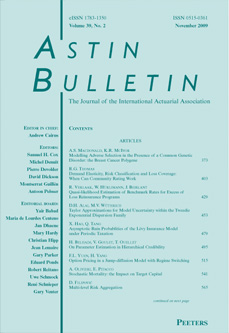
ASTIN Bulletin - The Journal of the IAA was founded in 1958 as a journal providing an outlet for actuarial studies in non-life insurance. In the late 1980's the journal extended its scope to encompass the study of financial risk in insurance (AFIR). In 2007, the journal was established as the journal of the International Actuarial Association (IAA) and encompasses all of the scientific sections of the IAA.
ASTIN Bulletin - The Journal of the IAA publishes papers that are relevant to any branch of actuarial science and insurance mathematics. Papers should be quantitative and scientific in nature, and might draw on theory and methods developed in any branch of the mathematical sciences including actuarial mathematics, statistics, probability, financial mathematics and econometrics.
The journal welcomes papers that present significant and original theoretical developments and papers that present significant and original applications of mathematical, statistical or econometric theory to problems arising in insurance, pensions and finance. We especially welcome papers opening up new areas of interest to the international actuarial profession as well as papers that describe open problems that have arisen in practice.
Papers for possible publication in ASTIN Bulletin should be submitted online at: mc.manuscriptcentral.com/astin
ASTIN Bulletin is abstracted and indexed in the Social Sciences Citation Index, the Science Citation Index Expanded, the CompuMath Citation Index, and Current Contents/Social & Behavioral Sciences; MathSciNet; Zentralblatt MATH; Scopus; CrossRef; Thomson Scientific Links
Instructions to Authors
Bulletin Editorial Policy
ASTIN Bulletin started in 1958 as a journal providing an outlet for actuarial studies in non-life insurance. Since then a well-established non-life methodology has resulted, which is also applicable to other fields of insurance. For that reason ASTIN Bulletin has always published papers written from any quantitative point of view - whether actuarial, econometric, engineering, mathematical, statistical, etc. - attaching theoritical and applied problems in any field faced with elements of insurance and risk. Since the foundating of the AFIR section of IAA, i.e. 1988, ASTIN Bulletin has opened its editorial policy to include any papers dealing with financial risk.
We especially welcome papers opening up new areas of interest to the international actuarial profession.
ASTIN Bulletin appears twice a year (May and November).
It is now open to papers on all practice areas, including health, life, employee benefits, social security, etc.
Guidelines for Authors
1. Papers for publications should be sent in quadruplicate to one of the Editors:
|
Andrew Cairns
Department of Actuarial
Mathematics and Statistics
Heriot-Watt University
Edinburgh EH14 4AS
United Kingdom
A.Cairns@ma.hw.ac.uk |
Shaun Wang
Department of Risk Management
and Insurance
Georgia State University
35 Broad Street NW - 11th Floor
Atlanta, Georgia 30302-4036
shaunwang@gsu.edu |
Submission of a paper is held to imply that it contains original unpublished work and is not being submitted for publication elsewhere.
Receipt of the paper will be confirmed and followed by a refereeing process, which will take about three months.
2. The basic elements of the journal's style have been agreed by the Editors and Publishers and should be clear from checking a recent issue of ASTIN Bulletin. If variations are felt necessary they should be clearly indicated on the manuscript.
3. Papers should be written in English or in French. Authors intending to submit longer papers (e.g. exceeding 30 pages) are advised to consider splitting their contribution into two or more shorter contributions.
4. The first page of each paper should start with the title, the name(s) of the author(s), and an abstract of the paper as well as some major keywords. An institutional affiliation can be placed between the name(s) of the author(s) and the abstract.
5. Footnotes should be avoided as far as possible.
6. References should be arrange alphabetically, and for the same author chronologically. Use a, b, c etc. to separate publications of the same author in the same year. For journal references give author(s), year, title, journal (in italics, cf. point 9), volume (in boldface, cf. point 9), and pages. For book references give author(s), year, title (in italics), publisher, and city.
Example:
Barlow, R.E. and Proschan, F. (1975) Mathematical Theory of Reliability and Life Testing. Holt, Rinehart, and Winston, New York.
Jewell, W.S. (1975a) Model variations in credibility theory. In Credibility: Theory and Applications (ed. P.M. Kahn), pp. 193-244, Academic Press, New York.
Jewell, W.S. (1975b) Regularity conditions for exact credibility. ASTIN Bulletin 8, 336-341.
References in the text are given by the author's name followed by the year of publication (and possibly a letter) in parentheses.
7. The address of at least one of the authors should be typed following the references.
8. Italics (boldface) should be indicated by single (wavy) underlining. Mathematical symbols will automatically be set in italics, and need not be underlined unless there is a possibility of misinterpretation. Information helping to avoid misinterpretation may be listed on a separate sheet entitled 'special instructions to the printer'. (Example of such an instruction: Greek letters are indicated with green and script letters with brown underlining, using double underlining for capitals and single underlining for lower case).
9. Contributions must be typewritten on one side of good quality paper, with double spacing and ample margins all round.
Illustrations should be submitted as clear black and white prints. Photocopies are not acceptable. Line thickness and lettering size should be adopted to suit any likely degree of reduction.
Each Contribution should obtain the author(s) full address(es), including e-mail and fax numbers when available. Authors should notify the publisher whenever their contact details change.
A copy of text should also be submitted on disk, when available. Please state clearly the type of software used, and note the filename. Contributors should also retain a copy of their article.
Two sets of proofs will be shipped to authors who should ensure that one set plus the manuscript is returned to PEETERS within one week of receipt. Authors may be charged for alterations to the original manuscript. If authors proofs are not returned by the required date, the publisher's own corrected set will be forwarded to the printer.
10. Authors will receive 30 offprints free of charge. Additional offprints may be ordered when returning corrected proofs. A scale of charges will be enclosed when the proofs are sent out.
Editorial Board
Editor-in-Chief
|
Andrew Cairns
Department of Actuarial
Mathematics and Statistics
Heriot-Watt University
Edinburgh EH14 4AS
United Kingdom
A.Cairns@ma.hw.ac.uk |
|
Editors
|
Samuel H Cox
University of Manitoba
Warren Ctr-Actuarial Studies & Research
181 Freedman Crescent
Winnipeg, MB R3T 5V4
CANADA
scox@cc.umanitoba.ca
|
Michel Denuit
Universit¨¦ Catholique de Louvain
Institut des Sciences Actuarielles
Rue des Wallons, 6
B-1348 Louvain-la-Neuve
BELGIQUE
denuit@stat.ucl.ac.be |
Pierre Devolder
Universit¨¦ Catholique de Louvain
Institut des Sciences Actuarielles
Rue des Wallons, 6
B-1348 Louvain-la-Neuve
BELGIQUE
devolder@fin.ucl.ac.be |
Shaun Wang
Georgia State University
Dept of Risk Mgmt & Insurance
PO Box 4036
Atlanta, GA 30302-4036
UNITED STATES
shaunwang@gsu.edu |
Editorial Board
| 








 字顺( Alphabetical List of Journals):
 返回页首
返回页首 