期刊名称:GEOMECHANICS AND ENGINEERING
 期刊简介(About the journal)
投稿须知(Instructions to Authors)
编辑部信息(Editorial Board) 期刊简介(About the journal)
投稿须知(Instructions to Authors)
编辑部信息(Editorial Board)
About the journal
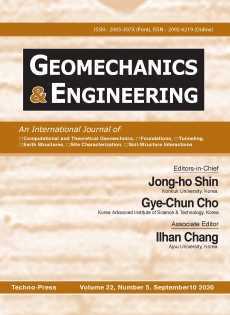
ISSN: 2005-307X(Print), ISSN: 2092-6219(Online)
 Impact factor:0.244(2012) Impact factor:0.244(2012)

| Aims and Scope |
| The Geomechanics and Engineering aims at opening an easy access to the valuable source of information and providing an excellent publication channel for the global community of researchers in the geomechanics and its applications. |
Typical subjects covered by the journal include:
 Analytical, computational, and experimental multiscale and interaction mechanics Analytical, computational, and experimental multiscale and interaction mechanics
Computational and Theoretical Geomechnics
Foundations
Tunneling
Earth Structures
Site Characterization
Soil-Structure Interactions |
Instructions to Authors
Instructions to Authors
|
| 1. Submission of the paper |
| Authors are asked to submit manuscripts in PDF format electronically through the Techno-Press Manuscript Upload System (TeMUS) (http://www.techno-press.org/papers). Exceptionally, the special issue papers may be directly submitted to the Guest Editor. If you have difficulties in using TeMUS, please contact us at[technop3@chol.com]. On receiving submitted papers, the system will issue the paper ID and Password to the corresponding author which may be conveniently used to check the status of submitted papers. |
| 2. Preparation of the manuscript |
General : The manuscripts should be in English and typed with single column and single line spacing on single side of A4 paper. Submitted papers will be published in three categories, i.e., 1) Regular technical paper, 2) Review papers and 3) Discussions. The first page of an article should contain; (1) a title of paper which well reflects the contents of the paper (Arial, 16pt), (2) all the name(s) and affiliations(s) of authors(s) (Arial, 12pt), (3) an abstract of 100~250 words (Times New Roman, 11pt), (4) 5-10 keywords following the abstract, and (5) footnote (personal title and email address of the corresponding author (required) and other authors' (not mandatory)). The paper should be concluded by proper conclusions which reflect the findings in the paper. The normal length of the technical paper should be about 14-20 journal pages. There will be no page charges and no other fees unless the author wishes arrangements to provide an open access to his article. Authors are advised to read the details in the Appendix A for guide, Appendix B for a template and Appendix C for index of the instructions to authors for the format of the first page of the paper.
Tables and figures : Tables and figures should be consecutively numbered and have short titles. They should be referred to in the text as following examples (e.g., Fig. 1(a), Figs. 1 and 2, Figs. 1(a)-(d) / Table 1, Tables 1-2), etc. Tables should have borders (1/2pt plane line) with the captions right before the table. Figures should be properly located in the text as an editable image file (.jpg) with captions on the lower cell. All of the original figures are required at the end of the manuscript for reference in editing.
Units and mathematical expressions : It is desirable that units of measurements and abbreviations should follow the System Internationale (SI) except where the other unit system is more suitable. The numbers identifying the displayed mathematical expression should be placed in the parentheses and referred to in the text as following examples (e.g., Eq. (1), Eqs. (1)-(2)). Mathematical expressions must be inserted as an object (set as Microsoft Equations 3.0) for Microsoft Word 2007 and after versions. Image-copied text or equations are not acceptable unless they are editable. The raised and lowered fonts cannot be used for superscription and subscription.
References : A list of references which reflect the current state of technology in the field locates after conclusions of the paper. For details to prepare the list of references and cite them in the text, authors are advised to follow the introduction and the sample list in the Appendix A and Appendix C of the instruction. |
| 3. Review |
| All the submitted papers will undergo a peer-review process, and those papers positively recommended by at least two expert reviewers will be finally accepted for publication in the Techno-Press Journals or after any required modifications are made. |
| 4. Proofs |
| Proofs will be sent to the corresponding author to correct any typesetting errors. Alterations to the original manuscript will not be accepted at this stage. Proofs should be returned within 48 hours of receipt. |
| 5. Copyright |
| Submission of an article to a Techno-Press Journal implies that it presents the original and unpublished work, and not under consideration for publication elsewhere. On acceptance of the submitted manuscript, it is implied that the copyright thereof is transferred to the Techno-Press. The Transfer of Copyright Agreement may also be submitted. |
*Appendix A. Authors' Guide
*Appendix B. Template
*Appendix C. Index
Editorial Board
| Editorial Board |
Prof. Tarek Abichou
Department of Civil & Environmental Eng
Florida State Univeristy
USA
Prof. Richard J. Bathurst
Civil Engineering Department
Royal Military College of Canada
Canada
Prof. Dennes T. Bergado
School of Eng and Tech
Asian Inst of Technology
Thailand
Prof. J.C. Chai
Department of Civil Engineering
Saga University
Japan
Prof. Claudio Cherubini
Dept of Civil and Environmental Eng
Technical Univ of Bari
Italy
Prof. Yean Khow Chow
Department of Civil Engineering
National University of Singapore
Singapore
Prof. Jian Chu
School of Civil and Environmental Engineering
Nanyang Technological University
Singapore
Prof. Daniel Dias
Civil Engineering
INSA de Lyon
France
Dr. Robin Fell
University of New South Wales
Syendy, NSW 2052, Australia
Prof. Anthony T.C. Goh
School of Civil & Environmental Eng
Nanyang Technological University
Singapore
Prof. I. M. Idriss
Dept of Civil and Environmental Eng
Univ of California at Davis
USA
Prof. Buddhima Indraratna
School of Civil Engineering
University of Wollongong
Australia
Dr. Akbar Javadi
Sch of Eng, Computing & Mathematics
University of Exeter
UK
Prof. Dong-Sheng Jeng
Geotechnical Engineering
Griffith University
UK
Prof. Seok Won Jeon
Schl of Civil, Urban & Geosystem Eng
Seoul Nat’l University
Korea
Prof. Takaji Kokusho
Department of Civil Engineering
Chuo University
Japan
Prof. Jyant Kumar
Civil Engineering Department
Indian Inst of Sci, Bangalore
India
Prof. Junhwan Lee
School of Civil & Environmental Eng
Yonsei University
Korea
Prof. Chun Fai Leung
Department of Civil Engineering
National Univ of Singapore
Singapore
Prof. Ning Lu
Department of Civil Engineering
Colorado School of Mines
USA |
Prof. Radoslaw L. Michalowski
Department of Civil Engineering
University of Michigan
USA
Prof. Harry G. Poulos
Geotechnical Engineering
Coffey Geotechnics
Australia
Prof. Anand J. Puppala
Dept of Civil and Environmental Eng
The Univ of Texas at Arlington
USA
Prof. Harianto Rahardjo
Sch of Civil and Environmental Eng
Nanyang Technological Univ
Singapore
Prof. Debasis Roy
Dept of Civil Engineering
Indian Inst of Technology
India
Prof. Julie Q. Shang
Dept of Civil & Environmental Eng
The University of Western Ontario
Canada
Prof. D.N. Singh
Department of Civil Engineering
Indian Inst of Tech, Bombay
India
Prof. V. Sivakumar
School of Civil Engineering
The Queen’s University of Belfast
UK
Prof. Kenichi Soga
Civil Engineering
University of Cambridge Cambridge
UK
Prof. Erxiang Song
Department of Civil Engineering
Tsinghua University
China
Prof. Abdul-Hamid Soubra
Inst de Rech en Genie Civil et Meca
Universite de Nantes
France
Prof. Luis E. Vallejo
Civil and Environmental Engineering
University of Pittsburgh
USA
Prof. Yu-Hsing Wang
Department of Civil Engineering
The Hong Kong Univ. of Sci. & Tech.
Hong Kong
Prof. Ron C.K. Wong
Dept of Civil Engineering
University of Calgary
Canada
Prof. Jun Yang
Department of Civil Engineering
The University of Hong Kong
Hong Kong
Prof. Jian-Hua Yin
Department of Civil & Structural Engineering
The Hong Kong Polytechnic Univ.
Hong Kong
Prof. Z. Q. Yue
Department of Civil Engineering
The University of Hong Kong
Hong Kong
Prof. Limin Zhang
Department of Civil Engineering
The Hong Kong Univ of Sci & Tech
Hong Kong
Prof. Xiong Zhang
Dept of Civil & Environmental Eng
University of Alaska Fairbanks
USA
Prof. Hehua Zhu
School of Civil Engineering
Tongji University
China
|
|

