期刊名称:STATISTICA SINICA
 期刊简介(About the journal)
投稿须知(Instructions to Authors)
编辑部信息(Editorial Board) 期刊简介(About the journal)
投稿须知(Instructions to Authors)
编辑部信息(Editorial Board)
About the journal
Aims and Scope
Statistica Sinica endeavors to meet the needs of statisticians faced with a rapidly changing world. It publishes significant and original articles that promote the principled use of statistics along with related theory and methods in quantitative studies, essential to modern technologies and sciences. It is published quarterly in January, April, July and October
Instructions to Authors
|
INSTRUCTIONS FOR AUTHORS |
| SUBMISSION |
|
Authors can electronically submit their manuscripts through the journal’s website, http://www.stat.sinica.edu.tw/statistica/submission. Papers submitted to STATISTICA SINICA must have neither been published previously nor been under review by another journal. Papers must be written in English and should normally not exceed 30 manuscript pages. Important references that are unpublished or difficult to access should be included with the submission. |
RESPONSIBLE CONDUCT
As all other journals, Statistica Sinica expects authors to adhere to ethical standards. To prevent carless conduct of plagiarism from happening, the journal provides this page of guidelines.
|
MANUSCRIPT PREPARATION
It is important that the following requirements are followed as closely as possible. A technically acceptable manuscript that fails to follow these requirements may be returned for retyping, leading to delay in publication.
The Latex templates for Windows and for Mac, respectively, are available on the journal site. Please click on Latex Template for accessing the files.
|
I. Layout
|
1. |
The manuscript, including references, should be typed and double-spaced. If a word-processor is used, the typesetting should not be smaller than 12 characters per inch (25mm). The margins should be at least 1.0 inch (25mm) on all four sides. Pages should be numbered consecutively. All copies of the manuscript must be legible. |
|
2. |
The paper should start with a short abstract followed by key words and phrases in alphabetical order. Avoid the inclusion of formulas in the abstract. |
|
3. |
Provide a short running title of no more than 45 characters. Give the work and email addresses of each author, and the phone and fax numbers of the corresponding author. |
|
4. |
The paper should be divided into numbered sections with short titles. Subsections may be used, but not sub-subsections. Each subsection should also have a number and title. |
|
5. |
Footnotes should not be used except for tables. |
|
6. |
References in the text should follow the current style in STATISTICA SINICA. A complete list of authors and editors should be given; et al. should not be used. References to books should be to the latest edition; a page, section or chapter number is normally necessary. For example, Box, Jenkins, and Reinsel(1994, Chap.9) consider.... The list of references at the end should correspond to those in the text. References to books or papers should include: title of book,editor(s), first and last page numbers of paper, publisher and where published.
For example,
Findley, D. F. and Wei, C.-Z. (1993). Moment bounds for deriving time series CLT's and model selection procedures. Statist. Sinica 3, 453-480.
McCullagh, P. and Nelder, J. A. (1989). Generalized Linear Models. Chapman and Hall, New York.
Stein, C. (1956). Efficient nonparametric testing and estimation. Proc. 3rd Berkeley Symp. Math. Statist. Probab. 1, 187-196, University of California Press, Berkeley, CA. |
|
7. |
Acknowledgement should appear at the end of the paper and be as brief as possible. Essential derivations should appear in a separate appendix, which follows the acknowledgements but precedes the references. Each appendix should have a separate title. Additional lengthy derivations can be submitted in a separate Portable Document Format (PDF) file as a web-based appendix.; please see “IV. Supplementary Documents” below for further instructions. | II. Formulas and Equations
|
8. |
Make efficient use of space. Avoid unnecessary display of formulas. Short formulas should be left in the text to save space where possible, but they must not be more than one line high. For example, a summation should be written as  (if the limits of summation are obvious) or (if the limits of summation are obvious) or  +... + +... +  . Also . Also  must not be left in the text; use must not be left in the text; use 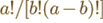 if necessary. The repeated appearance of lengthy expressions should be avoided by introducing suitable notation. Long or important equations should be displayed (i.e. shown on a separate line). Equation numbers should be included only for those equations that are referred to in the text and must be placed on the right. if necessary. The repeated appearance of lengthy expressions should be avoided by introducing suitable notation. Long or important equations should be displayed (i.e. shown on a separate line). Equation numbers should be included only for those equations that are referred to in the text and must be placed on the right. |
|
9. |
Multiple under- and overbars such as  must be avoided, as must must be avoided, as must  . Subscripts and superscripts should be aligned horizontally, or be clearly marked.Avoid higher-order sub- and superscripts. . Subscripts and superscripts should be aligned horizontally, or be clearly marked.Avoid higher-order sub- and superscripts. |
|
10. |
Any script letters should be clearly marked throughout. Distinguish between easily confused characters like  , , , , , , , , , , , , ; ; , , , , ; ; , , ; etc. ; etc. |
|
11. |
Use .gif) for expectation not for expectation not  or or .gif) ; ; .gif) not not  ;, ... , not , ;, ... , not , ,... ,; ,... ,;  or or  not or not or  . Avoid . Avoid  for product. for product. |
|
12. |
Symbols should not be used at the start of a sentence. Special symbols like  and and  should be avoided. Follow the usual conventions for brackets, exp, square root sign, etc. as in a recent issue. Do not use should be avoided. Follow the usual conventions for brackets, exp, square root sign, etc. as in a recent issue. Do not use  when the expression inside the square root sign is lengthy. when the expression inside the square root sign is lengthy. | III. Tables and Figures
|
13. |
Authors should number tables and figures separately in the order they are to be printed and referred to in the text. They should also be properly arranged to make efficient use of the STATISTICA SINICA sized page. Layouts that have to be printed sideways should be avoided. Each table and figure should have a short title or description that is as self-explanatory as possible. |
|
14. |
Original figure artwork must be submitted in a printable Portable Document Format (PDF) or PostScript (PS) file when a paper is accepted for publication. Photocopies are not acceptable. All color figures will be reproduced in their original formats in the online edition. Some color figures are also allowed to be printed in the paper edition if figures benefit scientifically from use of color. Authors must sign a request for color printing in additional to the copyright form before their manuscripts can be processed for publication. |
|
15. |
Artwork in STATISTICA SINICA is typically black and white. Only when figures benefit scientifically from use of color (e.g. the scan pictures), color figures are allowed to be printed in the paper edition. The corresponding author must alert the editors upon submission if color is absolutely necessary. Authors may submit figures that appear in black and white in the print version but in color in the online version. Under the circumstances, please note (1) the same figure must serve for both color and black and white and (2) figure captions and the text must not refer specifically to any color. | IV. Supplementary Documents
|
16. |
Supporting material that is not essential for inclusion in the full text of the manuscript, but would benefit the reader, can be made available as online- only content linked to the online manuscript as requested by the editors. Please ensure that the supplementary material is properly referred to in the main manuscript. Examples of material suitable for supplementary documents are detailed proofs, step-by-step computational procedures, extended data examples, and useful software codes. The online edition only accepts supplementary material in the PDF format and the material must be submitted to the editors at the same time as the revised manuscript. The size of the PDF file should not exceed 10MB, and must be as small as possible, so that it can be downloaded quickly. Please provide the same title and authors as the main manuscript for the supplementary document. The supplementary materials will be reviewed but will not be subject to copy-editing once the paper is accepted. Latex template for supplementary documents is also available in Latex Templates.
| |
Editorial Board
| Co-Editor: |
| Jeng-Min Chiou |
Academia Sinica, Taipei |
| Naisyin Wang |
University of Michigan, Ann Arbor |
| Qiwei Yao |
London School of Economics, London
|
| |
| Consulting Editor: |
| N. D. Ylvisaker |
University of California, Los Angeles |
| |
| Associate Editors: |
| J. Aston |
University of Cambridge, Cambridge |
| R. J. Carroll |
Texas A&M University, College Station |
| K.-S. Chan |
University of Iowa, Iowa City |
| N. H. Chan |
The Chinese University of Hong Kong, Hong Kong |
| K. Chen |
Hong Kong University of Science and Technology, Hong Kong |
| Y.-H. Chen |
Academia Sinica, Taipei |
| M.-Y. Cheng |
National Taiwan University, Taipei |
| A. Delaigle |
The University of Melbourne, Melbourne |
| H. Doss |
University of Florida, Gainesville |
| F. Ferraty |
Universite Paul Sabatier, Toulouse |
| D. Ghosh |
Penn State University, University Park |
| I. Hu |
Hong Kong University of Science and Technology, Hong Kong |
| H.-C. Huang |
Academia Sinica, Taipei |
| J. Jin |
Carnegie Mellon University, Pittsburgh |
| J. K. Kim |
Iowa State University, Ames |
| C. Lam |
London School of Economic, London |
| L. Levina |
University of Michigan, Ann Arbor |
| B. Li |
Penn State University, University Park |
| W.-K. Li |
The University of Hong Kong, Hong Kong |
| Y. Liu |
The University of North Carolina at Chapel Hill, Chapel Hill |
| W. L. Loh |
National University of Singapore, Singapore |
| J. Lv |
University of Southern California, Los Angeles
|
| Z.-M. Ma |
Academy of Math. and System Science, Beijing |
| E. Mammen |
University of Mannheim, Mannheim |
| M. Martin |
Australian National University, Canberra |
| R. Mukerjee |
Indian Institute of Management, Calcutta |
| B. Nan |
University of Michigan, Ann Arbor |
| D. Paul |
University of California, Davis |
| H. Peng |
Hong Kong Baptist University, Hong Kong |
| L. Peng |
Georgia Institute of Technology, Atlanta |
| M. Podolskij |
Heidelberg University, Heidelberg |
| P. Z. G. Qian |
University of Wisconsin-Madison, Madison |
| R. Samworth |
University of Cambridge, Cambridge |
| P. Song |
University of Michigan, Ann Arbor |
| L. Stefanski |
North Carolina State University, Raleigh |
| S.G.Walker |
University of Texas at Austin, Austin |
| H. Wang |
Peking University, Beijing |
| H. Wang |
Colorado State University, Fort Collins |
| M.-C. Wang |
The Johns Hopkins University, Baltimore |
| F. Yao |
University of Toronto, Toronto |
| Y. C. Yao |
Academia Sinica, Taipei |
| Y. Yu |
University of Cincinnati, Cincinnati |
| C.-H. Zhang |
Rutgers University, Piscataway |
| J.-T. Zhang |
National University of Singapore, Singapore |
| L. H. Zhao |
University of Pennsylvania, Philadelphia |
| J. Zhou |
University of Virginia, Charlottesville |
| H. Zhu |
University of North Carolina at Chapel Hill, Chapel Hill |
| L.-X. Zhu |
Hong Kong Baptist University, Hong Kong |
| Z. Y. Zhu |
Fudan University, Shanghai |
| H. Zou |
University of Minnesota, Minneapolis |
| |
| Managing Editor: |
| H. Tsai |
Academia Sinica, Taipei |
| |
| Editorial System Manager: |
| C. S. E. Cheng |
Academia Sinica, Taipei |
| |
| Past Chair Editors: |
| G. C. Tiao |
University of Chicago, Chicago (1991-1993) |
| C. F. J. Wu |
University of Michigan, Ann Arbor (1993-1996) |
| C. S. Cheng |
Academia Sinica, Taipei (1996-1999) |
| K. C. Li |
University of California, Los Angeles(1999-2002) |
| Y. C. Yao |
Academia Sinica, Taipei(1999-2002) |
| H. C. Ho |
Academia Sinica, Taipei(2002-2005) |
| J. L. Wang |
University of California, Davis(2002-2005) |
| M. Liou |
Academia Sinica, Taipei (2005-2008) |
| X.-L. Meng |
Harvard University, Cambridge (2005-2008) |
| P. Hall |
The University of Melbourne, Melbourne (2008-2011) |
| J.-S. Hwang |
Academia Sinica, Taipei (2008-2011) |
| K.-Y. Liang |
The Johns Hopkins University, Baltimore (2008-2011) |
| |
| Editorial Assistants: |
| C. Y. Lai |
Academia Sinica, Taipei |
| J. N. Lin |
Academia Sinica, Taipei |
| S. H. Mo |
Academia Sinica, Taipei |
|

