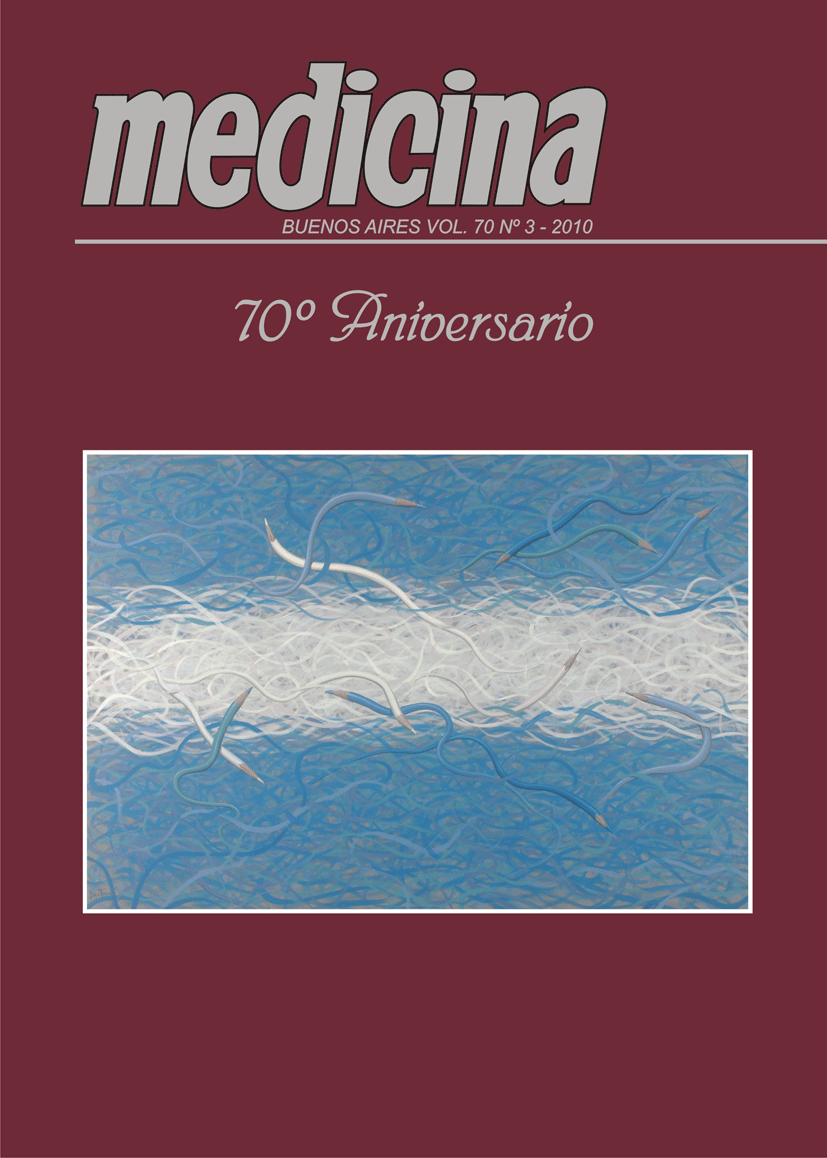
期刊名称:MEDICINA-BUENOS AIRES
 期刊简介(About the journal)
投稿须知(Instructions to Authors)
编辑部信息(Editorial Board) 期刊简介(About the journal)
投稿须知(Instructions to Authors)
编辑部信息(Editorial Board)
About the journal

Publicada con el apoyo del Ministerio de Ciencia, Tecnología e Innovación Productiva. MEDICINA no tiene propósitos comerciales.
El objeto de su creación ha sido propender al adelanto de la medicina argentina. Los beneficios que pudieran obtenerse serán aplicados exclusivamente a este fin.
Aparece en MEDLINE (PubMed), ISI-THOMSON REUTERS (Journal Citation Report, Current Contents, Biological Abstract, Biosis, Life Sciences), CABI (Global Health), ELSEVIER (Scopus, Embase, Excerpta Medica), SciELO, LATINDEX, BVS (Biblioteca Virtual en Salud), Google Scholar y Google Books.
Instructions to Authors
Submission of manuscripts. The manuscript should be submitted by online sub-
mission (the complete file containing text, tables and figures, attached to e-mail) to
revmed@intramed.net. Simultaneously, two printed copies should also be sent by
registered mail to our postal address. The first page must contain: (a) the title (in-
formative but short); (b) the complete name of the authors, and the denomination of
their institutions; (c) a running title for page heading, and (d) the complete postal
address of the corresponding author, including fax and electronic address. A cover-
ing letter signed by all authors, stating that the contents of the article have not been
published elsewhere, and indicating the journal section in which the article should
appear, will accompany the manuscript. Only those who participated directly in the
research or the drafting of the article, and are therefore in a position to assume pub-
lic responsibility for its contents, may be listed as authors. For these reasons an
article should have a maximum of 6 authors. If more than 6, the contribution of each
author should be explained in the covering letter. The standards for authorship are
extensively explained in http://www.icmje.org. Copyright of articles published is held
by MEDICINA. Those who wish to reproduce material from the journal must request
written permission from the Editorial Board. Likewise, authors of articles published in
MEDICINA who wish to include material from other copyrighted sources must seek
permission from the copyright holders and provide written evidence of this permis-
sion at the time the article is submitted.
The journal sections include: Original Articles (full articles and Short Communica-
tions), Special Articles, Case Reports, Clinic-pathological Conferences, Images in
Medicine, Editorials, Letters to the Editor and Book Reviews. English and Spanish
are equally suitable for Original Articles and Short Communications. Manuscripts should be prepared using Microsoft Word (Excel, Power Point, or other graphic software for the
illustrations) on white paper (letter or A4), with margins of at least 25 mm, on only one
side of the paper, double spacing, in letter font type Times New Roman 12, Arial 12, or
other of a similar size. Pages must be consecutively numbered starting by the title page.
Units of measurement: metric units should be used, with decimal points. Abbrevi-
ations and Symbols: only standard abbreviations will be used. Avoid abbreviations
in the title and abstract. The full term for which an abbreviation stands shouldpre-
cede its first use in the text unless it is a standard unit of measurement.
Full articles should contain the following sections: Introduction (with no any head-
ing), Materials and Methods, Results, Discussion. An Abstract written both in Eng-
lish and Spanish will be included. If the article has been presented in English, the
title in Spanishshould precede the Abstract in this language (Resumen). The Ab-
stracts will follow the title page, will not exceed 250 words each, and will avoid the
mention of tables and figures. Three to six key words in English and in Spanish
should be added after the corresponding abstract, preferably selected from Index
Medicus (Medical Subject Headings, MeSH). In the Introduction the purposes of
the article are stated, and the rationale for the study is summarized. Do not include
data or conclusions from the work being reported. Materials and Methods include a
description of (a) selection of the studied subjects, and their characteristics; (b) me-
thods and procedures. In clinical trials complete information on all major elements of
the protocol (study population, intervention or exposures, outcomes, rationale for
statistical analysis) will be included; (e) ethical standards and guidelines followed will
be indicated (see below); (d) Statistical methods will be described. Results should
be presented in logical sequence. Data presented in tables or figures should not be
repeated in the text. In the Discussion new and important aspects of the study and
the conclusions that from them are followed as well as their relations with the objec-
tives stated in the Introduction. Do not repeat in detail data or other material already
given in previous sections. Avoid claiming priority and alluding to work that has not
been completed. When appropriate Acknowledgements will be added, before the
references section. There the provision of technical help, financial support, and con-
tributions that do not justify authorship may be listed. In these cases authors should obtain a written permission from these persons to be acknowledged. Conflicts of interest should be declared. References should be limited to those papers directly related to the article, and num-
bered consecutively in the order in which they are first mentioned in the text. All authors will be included if they are six or less; if more than six, the third one will be followed by “, et al” (et alia: and others). The titles of journals should be abbreviated according to the style used in Index Medicus (also available in http://www.nlm.nih.gov). Use superscript numerals for references in the text. List the References for journals, books and book chapters, and Internet sites, according to the following examples.
1. van Klaveren RJ, Oudkerk M, Prokop M, et al. Management of lung nodules detected by volume CT scanning. N Engl J Med 2009;361: 2221-9.
2. World Health Organization. Global tuberculosis control: surveillance, planning, financing. WHO report 2005. WHO/HTM/TB/2005.349. Geneva: World Health Organization, 2005.
3. Philips DJ, Whisnant JP. Hypertension and stroke. In: Laragh JH, Brenner BM, eds. Hypertension: pathophysiology, diagnosis, and management, 2nd ed. New York: Raven Press, 1995, p 465-78.
4. Helman A. Air pressure and Mount McKinley. En: http://www.cohp.org/ak/notes/
pressure_altitude_simplified_II.html; accessed 19 October 2009.
Personal communications are cited in the text. Tables should not repeat information already mentioned in the text, and should be typed on separate pages, with a brief but explicit title, consecutively numbered (Arabic numbers). They should be indispensable and comprehensible by themselves. Do not use internal horizontal and vertical rules. Place explanatory matter in footnotes, not in the heading. Figures (graphs, or black and white photographs) must allow for adequate reproduction and must be numbered and identified on the back of the page in the manuscript. The explanatory legends shall be written on a separate page. The symbols, arrows or letters eventually used must contrast properly against the background. With an additional cost of US$ 50, a Figure could be edited in black and white on the paper Journal, but in color in www.medicinabuenosaires. For that purpose, the authors should send separately both files (for black and white and color versions).
Special Articles refer to those topics that need to be updated; they must be based on an important bibliographic revision, and should not exceed 7000 words.
Short Communications refer to results which justify publication because of their special interest, however preliminary. The manuscript should not exceed 2500 words, without sections, nonetheless containing the customary sequence, with no
more than 15 references and 2 tables or figures. A Short Communication will be published within 3 months of acceptance. Case Reports should be accepted on the bases of their clinical interest. They should have the following sections: Introduction, Case Report, and Discussion. The manuscript should not exceed 1500-2000 words including up to 2 tables or figures and no more than 15 references. An Abstract in English and in Spanish will also be included in Short Communications and Case Reports.
Images in Medicine may be radiographs, electrocardiograms (EKG records),echographs,angiographs,tomography,Magnetic Resonance Images (MRI), optic or electron microscopy, etc. Such images, not necessarily exceptional in their uality but illustrative, should not exceed one page in length, including an explanatory legend not xceeding 200 ords. The images should be provided in black and white, and allow a good quality reproduction. These images can lso appear in color in the on line edition with an additional cost of US$ 50 (total cost for publication in both versions US$ 140). A Section of Images only in color includes images which only appear in the on line edition though they figure in the journal index. The cost of each image published in this section is US$ 100.
Letters to the Editor should refer to editorial comments, preferably of articles published in MEDICINA. They Should not exceed 3 pages including up to 6 references and one Table or Figure. The opportunity and the eventual characteristics of the Editorials will be left to the decision of the Editorial Board. Manuscripts are examined by the Editorial Board members and by one or two outside reviewers. Articles, which are accepted, will undergo an editorial process that may involve deletions and additions.
Final version. Upon acceptance the authors are required to provide the complete final version via on line, attached to e-mail, to revmed@intramed.net, and two printed copies by registered mail to our postal address.
Authors will be charged for: if the article is accepted, US$ 70 per each printed page.
This sum includes the provision of 50 reprints.
Editorial Board
Héctor O. Alonso
Juan Antonio Barcat
Amadeo P. Barousse
Damasia Becú Villalobos
María Marta E. Bracco
Tomás Caeiro
Carlos G. del Bosco
Samuel Finkielman
Guillermo Jaim Etcheverry
Isabel N. Kantor
Basilio A. Kotsias
Daniel A. Manigot
Jorge A. Manni
Rodolfo S. Martín
Isabel N.P. Miceli
Christiane Dosne Pasqualini
Rodolfo C. Puche
Julio C. Sánchez Ávalos
Guillermo B. Semeniuk
|