期刊名称:GEOLOGICAL MAGAZINE
 期刊简介(About the journal)
投稿须知(Instructions to Authors)
编辑部信息(Editorial Board) 期刊简介(About the journal)
投稿须知(Instructions to Authors)
编辑部信息(Editorial Board)
About the journal
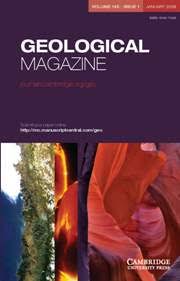
Geological Magazine, established in 1864, is one of the oldest and best-known periodicals in earth sciences. It publishes original scientific papers covering the complete spectrum of geological topics, with high quality illustrations. Its worldwide circulation, attractive layout, Rapid Communications section and extensive Book Review section keep the journal at the forefront of important publications in the field.
Instructions to Authors
All contributions
Contributions for publication, accompanied by a covering letter, should be addressed to The Editors,
Geological Magazine, Department of Earth Sciences, Downing Street, Cambridge CB2 3EQ, UK, or may be submitted through a member of the Editorial Board (addresses inside front cover). Submission implies that the manuscript has not been published previously nor currently submitted for publication elsewhere. Authors of papers published in the journal assign copyright to Cambridge University Press (with certain rights reserved), and will receive a copyright assignment form for signature on acceptance of their paper. All contributions, whether Articles, Rapid Communications or Discussions, must be sent in triplicate and typed on one side of the paper, with wide margins and double-line spacing throughout, with a font size no smaller than 12 point Times equivalent; three copies of all illustrations should also be sent. Contributions should follow the general style of papers in recent issues of the Magazine. Authors should provide the final version of the contribution on disk (Mac or PC format, Word or Wordperfect) in addition to the paper copies; authors also should suggest up to five possible referees, who will not necessarily be used. Book reviews are published by the invitation of the Editors, and should not be submitted independently.
Articles
These must be accompanied by a brief, informative rather than indicative, abstract. Headings should be
set out clearly but not underlined. Primary headings should be in lower case, at margin, with arabic
numerals; subheadings should be numbered 2.a., 2.b., etc., and tertiary headings 2.a.1., 2.a.2. No cross-referencesshould be given by page number, but 'above' and 'below' should be used with the section specified, e.g. Section 2.a.2. The SI system of units should be used. Avoid acronyms. The author should mark in the margin of the manuscript where figures and tables may be inserted. References to points in larger works should, where possible, quote the page reference, e.g. Ager, 1981, p. 102. Authors alone are responsible for the correctness of their references. Use 'et al.' in the text only when the work cited has four or more authors.
Rapid Communications
These should follow the style of Articles and must be no more than four printed pages of the Magazine
(approximately 5000 word-equivalents) including an abstract of no more than 100 words. These
contributions will be dealt with by a streamlined schedule and should appear within six months from
receipt. To meet this schedule, authors will be required to make revisions with minimal delay.
Discussions
Discussions of papers which have already appeared in the Magazine are welcomed, subject to the four-page limit.
Tables and figure captions
These should be typed with double-line spacing on sheets separate from the running text and figures.
Each table must have a caption that will make the data in the table intelligible without reference to the
text.
References
References must be double-spaced and spelt out in full, e.g.
COCKS, L. R. M. & FORTEY, R. A. 1982. Faunal evidence for oceanic separations in the Palaeozoic of Britain. Journal of the Geological Society, London 139, 465¨C78.
Books should be cited as:
AGER, D. V. 1981. The Nature of the Stratigraphical Record, 2nd ed. London: Macmillan, 122 pp.
CRIMES, T. P., LEGG, I., MARCOS, A. & ARBOLEYA, M. 1977. ?Late Precambrian¨Clower Cambrian trace fossils from Spain. In Trace Fossils 2 (eds T. P. Crimes and J. C. Harper), pp. 19¨C34, Geological Journal Special Issue no. 9. Liverpool: Seel House Press.
Unpublished work should normally be referred to in the text in parentheses as, for example, 'pers. comm.'or 'J. M. Brown, unpub. Ph.D. thesis, Univ. London, 1988', and not included in the reference list unless in the press.
Offprints
Fifty offprints of each paper will be provided free of charge. Additional offprints may be purchased
according to a set scale of charges if ordered when the proofs are returned.
Contributions submitted on disk
Authors should provide their manuscript on disk (Mac or PC format, Word or Wordperfect) as well as the paper copies. Please state the format, programs and versions used on the disk.
The author names in the reference list should have initial capital letters, with character style 'small
capitals' for the rest of the name; failing this upper and lower case; do not use all upper-case characters
(even of differing font sizes). In Word 5 you can make small capitals by highlighting the lower-case
letters, and typing Command-Shift-H; in Word 6 by typing Command-Shift-K. The result may not look
much different from regular capitals on your screen, but it will show up in print. This style change will
not work by highlighting upper-case letters, hence the request not to use upper-case alone.
Please use italic font rather than underline throughout the manuscript for words that should be italicized.
Do not use the 'bulletted list' word processing facility available in some programs, as this does not
translate into print.
Artwork
Please present figures for printing at either single column (80 mm) or double column (169 mm) width; the height of figures may vary in either width up to full print area height (240 mm). Figures should be
designed to be set portrait if possible; please submit figures at final publication size. Redrafting or size
reduction may be required by the editors if major savings in print area can be achieved without loss of
clarity. Separate components of any one figure should be labelled with lower-case letters, e.g. Figure
6a,b,c. Detailed maps or multiple logs may well require a whole page and the size of the lettering should be appropriate; avoid gross disparities in lettering size on figures. Folding figures will not be accepted; where necessary break a figure into two facing pages. Landscape figures should have no lettering upside down on the final printed page. Boxes of ornament and symbols should be explained within the figure, not in the caption.
Monochrome line subject illustrations supplies as hard copy
only
These should have the author's name and figure number clearly marked on the back of each piece of
artwork. The figures will be scanned at 1200 dpi and compressed using Packbits or LWZ. Scanning can
cause problems with some fine ornaments and any grey tints used (e.g. they can block in, a Moir¨¦
interference pattern can be produced, or poor quality, patchy tints result). They may look fine in desktop publishing, but they do not transpose through the several stages into print. Plain black/white is acceptable,but all other shades/tints should be replaced with distinct PostScript fills or custom fills.
Monochrome line subject illustrations supplied in digital form
Freehand and Illustrator are the preferred graphics packages. Before sending us your artwork, please do
the following:
*Where possible, please supply illustrations as TIFF or EPS files (300¨C400 dpi). Do not supply as
PostScript files as these cannot be included in integrated make-up, or worked on in any way.
*Draw or scan line art to finished size with appropriate line weights and typefaces (see 'Fonts' below).
*Indicate the file format (e.g. TIFF or EPS), the graphics software that you have used in originating the
artwork files (e.g. Freehand 7.0, Illustrator 8.0, etc.) and the computer operating system used (e.g. Mac
OS 8.5, Windows NT).
*Supply a laser print of all figures. List the name and version of the artwork package used and the names
and libraries of fonts used in the artwork or EPS files.
Pattern fills and tints
Artwork packages do not always generate pattern fills for output on imagesetters. Different imagesetterswill interpret them differently and the result often looks pixellated or 'bit-mappy'. Where possible,PostScript fills, custom fills and conventional tints should be used. PostScript fills frequently do not display well on screen but they do print out correctly.
It is best to avoid the use of complex or very detailed tints, patterns and symbols:
*They seldom reproduce adequately when reduced to fit the page or for use in a caption or legend.
*They may be completely illegible when represented on a screen (for example during page make -up, or on the WWW) or when output on low quality laser printers.
Please therefore:
*Use only the tints, patterns and symbols shown here.
*Use conventional fills: solids, tints, lines or cross-hatching.
*Use a PostScript fill if possible.
*Do not use a screen value above 133 lpi. Generally 100 lpi is better (even when scanned at high
resolution finer tints do not reproduce satisfactorily when reduced).
*If possible, use just one type of screen (line angle or dot shape) and one screen value throughout the
document.
*Do not use pattern fills from a graphics program as these are usually bitmap patterns which do not
output adequately to film recorders or imagesetters.
*Do not use colour tints, even if the figure is intended for monochrome printing; use
black/white/greyscale.
*Do not use 'hairline' line widths in graphics packages.
Tints
Patterns
Symbols
Monochrome half-tone subjects
Figures composed of photographs should be unscreened glossy prints presented at publication scale; each component part should be named with a lower-case letter. Photographic artwork is numbered as part of the sequence of figures, not as separate plates
If supplying these in digital form, your repro house should follow these instructions:
*Scanning: Scan at a resolution that is about twice the intended screen value; for example, scan at 300 dpi for 133 or 150 screen.
*Dot range: Set the dot range from 7% to 93% when the reproduction will be dot-for-dot from bromide
on our Opticopy machine. When supplying half-tones for direct output to film (i.e. for electronic merging, or planning in film) set the dot range from 1% to 96%.
*Data files: Supply data as TIFF files; if you wish to compress them, use a lossless compression package such as Packbits or LZW.
*Laser proofs: Supply a laser proof of all figures. List the name and version of the artwork package used and the names and libraries of fonts used in the artwork.
Colour half-tone or line subjects
The Magazine will be able to publish a limited number of free colour plates each year; the editors will
decide which plates to accept on their scientific merit. Authors submitting colour plates are asked to give detailed reasons why colour is necessary.
If intended as part of the normal sequence of figures, colour half-tones can successfully be printed in
monochrome. Do not submit line subject drawings with coloured tints except with permission as a colour plate; use only black/white/greyscale.
If supplying colour subjects in digital form, submit as TIFF or EPS files and choose CMYK colour mode when saving your scans.
Fonts
Cambridge has Monotype, Adobe and Bitstream font libraries. Please restrict the typefaces used in
electronic artwork to these. Do not send us fonts if you do not have a licence that permits you to copy
them to us.
Check lists
Always supply a printed directory of file names, laser proofs of all the figures, and a list of
fonts/typefaces used in labelling artwork.
Transfer media
You can supply artwork files to the Geological Magazine on any of the following media:
Apple Mac
* Floppy disks at 3.5 inch
* 44 Mb/88 Mb/200 Mb Syquest disks at 5.25 inch
*270 Mb Syquest disk at 3.5 inch
* 128 Mb and 230 Mb optical disks (MOD) at 3.5 inch
*100 Mb ZIP drive
*650 Mb, 1.3 Gb and 2.6 Gb optical disks at 5.25 inch
* CD-ROM
PC Windows 3.1, 95 and NT
* Floppy disks at 3.5 inch
* 100 Mb ZIP drive
* 128 Mb and 230 Mb optical disks at 3.5 inch
* 135 Mb and 270 Mb Syquest EZ Flyer
* CD-ROM
Virus check
Before despatching your disk please run it through a virus checker program which has up-to-date virus
patterns. If possible, also check Word and Excel files for macro viruses.
©Cambridge University Press 2002
Editorial Board
Editor
Dr Graham E. Budd
Department of Earth Sciences
Historical Geology and Palaeontology
University of Uppsala
SE-752 36 Uppsala
Sweden
Email graham.budd@pal.uu.se
Dr M. B. Allen
Cambridge Arctic Shelf Programme
181a Huntingdon Road
Cambridge CB3 0DH
UK
Dr D. M. Pyle
University of Cambridge
Department of Earth Sciences
Downing Street
Cambridge CB2 3EQ
UK
Email geolmag@esc.cam.ac.uk
Assistant Editor
Mrs Jane Holland
University of Cambridge
Department of Earth Sciences
Downing Street
Cambridge CB2 3EQ
UK
Email geolmag@esc.cam.ac.uk
Book Review Editor
Book Review Editor
Geological Magazine
Department of Earth Sciences
University of Cambridge
Downing Street
Cambridge CB2 3EQ
UK
Email geolmag@esc.cam.ac.uk
Editorial Board
Dr P. L. Gibbard
University of Cambridge, UK
Dr K. J. McNamara
Western Australian Museum, Perth, Australia
Dr R Damian Nance
Ohio University, USA
Professor R. J. Norris
University of Otago, New Zealand
Dr M. P. Smith
University of Birmingham, UK
| 

